DATA MANAGEMENT PLATFORM
Deliver Trusted, Unified Data with Qlik's Data Management Platform
Manage, govern, and deliver trusted data with comprehensive data management capabilities. Unify data across sources, ensure governance, and fuel analytics, AI, and business transformation initiatives.

Build a foundation for reliable, AI-ready data across the enterprise
Establish comprehensive data management that combines integration, quality, governance, and delivery into a unified platform that ensures every analytics and AI initiative starts with trusted data.

Centralize and control data from every source and system
Connect to databases, applications, cloud platforms, and files with unified data management that eliminates fragmentation while maintaining visibility and control across your entire data estate.

Automate governance, quality, and lineage at scale
Implement enterprise-wide data standards with automated quality checks, policy enforcement, and lineage tracking that maintain data trust without creating manual bottlenecks or delays.

Deliver accurate, business-ready data for analytics and AI
Provide governed, high-quality data to analytics platforms, machine learning models, and business applications with automated pipelines that ensure consistent, timely data availability.
How does Qlik's data management platform work?
Step 1 - Connect and consolidate data from multiple environments
Step 2 - Cleanse, transform, and catalog data automatically
Step 3 - Govern, secure, and monitor data quality
Step 4 - Deliver trusted data to analytics, AI, and business systems

Why Qlik data management?
With Qlik, you get enterprise-grade governance, AI-augmented insights, and the flexibility to solve real-world business challenges your way.

Complete data lifecycle management and control
Manage every aspect of data from ingestion through consumption with integrated capabilities for quality, governance, security, and delivery that ensure enterprise-wide data trust.

Consistent management regardless of deployment
Deploy data management consistently across AWS, Azure, Google Cloud, and on-premises infrastructure with centralized control that adapts to your evolving technology landscape.

AI-driven automation for operational efficiency
Leverage machine learning to automate data profiling, quality monitoring, policy recommendations, and metadata management that reduces manual effort while improving data trust.
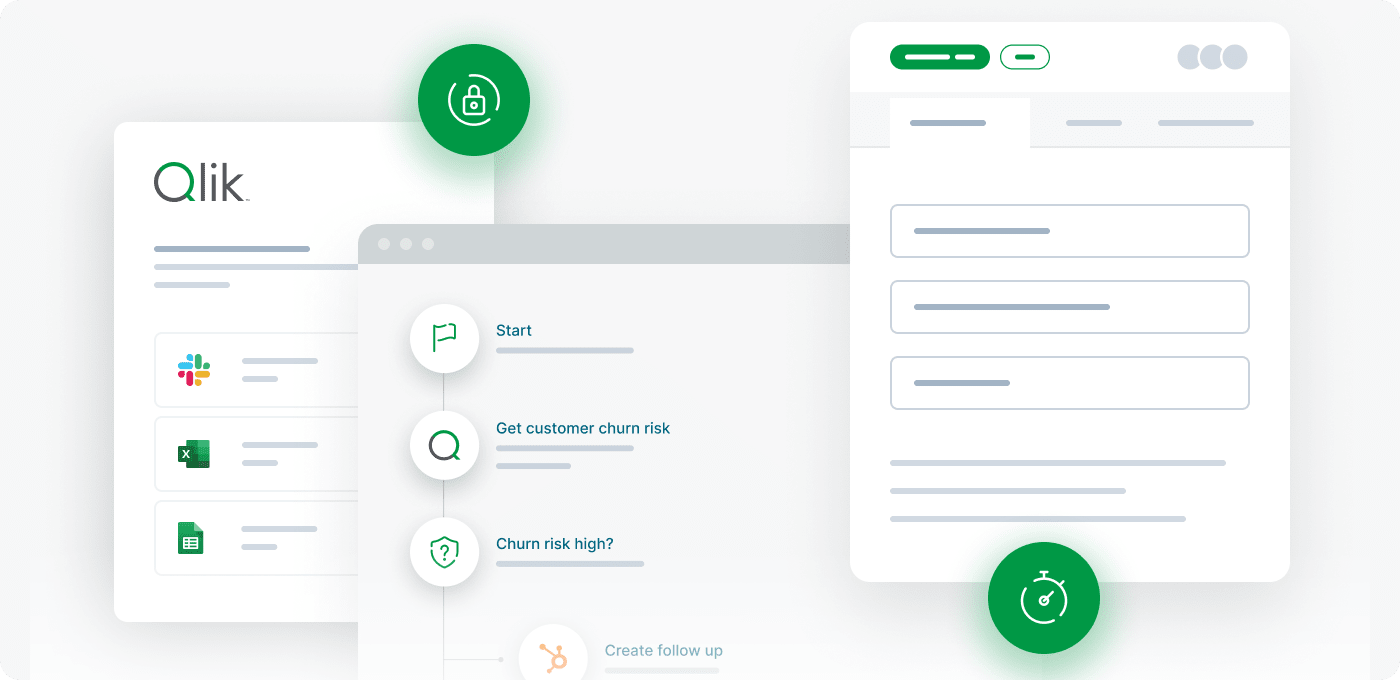
Enterprise-grade platform for mission-critical data
Scale from gigabytes to petabytes with distributed architecture that maintains performance while providing the security, reliability, and governance required for business-critical operations.

Trusted by industry leaders worldwide
Join thousands of organizations that rely on Qlik's data management platform to establish data trust, accelerate analytics, and enable AI initiatives with comprehensive data management.
Key capabilities of Qlik's data management platform
Qlik Business Data Analytics software empowers users at every level to make smarter decisions with governed, high-quality data they can trust. Built for scale, Qlik works seamlessly across departments, regions, and hybrid cloud environments.

Data ingestion and transformation
Capture data from sources continuously with change data capture and streaming ingestion that applies transformations, ensuring downstream systems receive current information.

AI-driven data quality and master data management
Maintain data accuracy with automated quality rules, deduplication, and master data management that establishes golden records and resolves conflicts using intelligent matching algorithms.

Data cataloging and metadata management
Organize enterprise data with intelligent catalogs that automatically classify assets, recommend business terms, and enable discovery through search and recommendation engines.

Automated lineage, compliance, and security controls
Track data flow with column-level lineage while enforcing access policies, encryption, and compliance requirements that protect sensitive information and maintain regulatory adherence.

Integration with analytics, BI, and cloud ecosystems
Connect seamlessly with analytics platforms, BI tools, data warehouses, and cloud services through native integrations that simplify data delivery and enable unified experiences.

Self-service access for business and data teams
Empower users to discover, request, and consume data independently through intuitive interfaces that hide complexity while maintaining governance and security controls.
Trusted by leading enterprises worldwide


What our customers say


We needed to consolidate data in one place, from heterogeneous sources, updated in almost real-time. That’s what Qlik enables for us.


Connect to 500+ data sources with Qlik’s analytics integrations

SAP

Adobe

IBM

AWS

MySQL

Jira

Azure

MS SQL

Apache

Mongo DB
SAP
Adobe
IBM
AWS
MySQL
Jira
Azure
MS SQL
Apache
Mongo DB
SAP
Adobe
IBM
AWS
MySQL
Jira
Azure
MS SQL
Apache
Mongo DB
SAP
Adobe
IBM
AWS
MySQL
Jira
Azure
MS SQL
Apache
Mongo DB
SAP
Adobe
IBM
AWS
MySQL
Jira
Azure
MS SQL
Apache
Mongo DB

Oracle

Salesforce

Workday

Apache Iceberg

CircleCI

Zendesk

Snowflake

Databricks


OpenAI

Intuit
Oracle
Salesforce
Workday
Apache Iceberg
CircleCI
Zendesk
Snowflake
Databricks
OpenAI
Intuit
Oracle
Salesforce
Workday
Apache Iceberg
CircleCI
Zendesk
Snowflake
Databricks
OpenAI
Intuit
Oracle
Salesforce
Workday
Apache Iceberg
CircleCI
Zendesk
Snowflake
Databricks
OpenAI
Intuit
Oracle
Salesforce
Workday
Apache Iceberg
CircleCI
Zendesk
Snowflake
Databricks
OpenAI
Intuit
Resources to help you succeed with data management


Data management platform FAQs
We provide comprehensive data management beyond integration—combining data quality, governance, cataloging, and delivery in a unified platform rather than requiring multiple disparate tools.
Yes, we support both batch ETL and streaming with unified management that enables you to process data using the approach that best matches each use case's latency requirements.
We apply automated profiling, validation rules, and quality scoring across all data, with machine learning that identifies anomalies and suggests improvements based on patterns in your data.
The platform includes schema evolution handling that automatically detects and adapts to structural changes, with configurable options for how to handle breaking changes and notification workflows.