Implement an enterprise data fabric with advanced
data integration software for AI and analytics

Implement an enterprise data fabric for AI and analytics
Bring together virtually any data source, format, or target to ensure that your business users and data scientists always have up-to-date data, whenever they need it.

Ensure enterprise-grade trust
Streamline end-to-end data management by providing high-quality, curated, and readily accessible, trusted data.

Easily meet constantly changing requirements
Automated, AI augmented, cloud-independent and technology agnostic solutions eliminate the data barriers between business and IT.
Qlik Talend Cloud® - transform, govern, and deliver your data with trusted agents


Work with a market leader in data integration software
Gartner
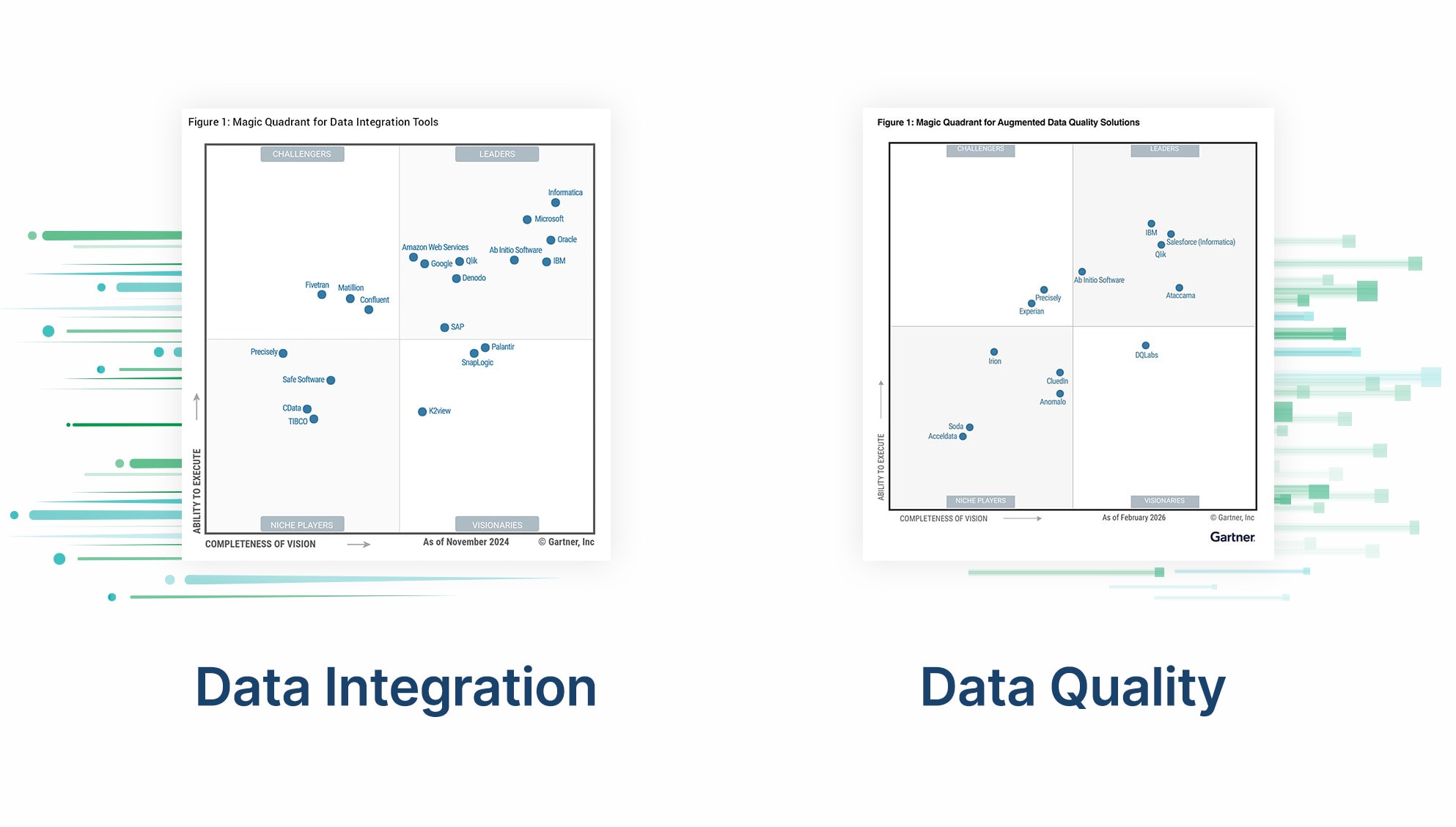
For ten years, Gartner® has positioned Qlik® as a Leader in its Magic Quadrant™ for Data Integration Tools.
Gartner
See why Qlik was named a Leader in the 2026 Gartner® Magic Quadrant™ for Augmented Data Quality Solutions for the seventh time.
BENEFITS
Simplify your approach to enterprise data integration

Get an adaptable real-time solution for delivering enterprise data to virtually any destination, on-premises or in the cloud
Universal data source and target connectivity - including Apache Iceberg
AI-augmented data movement, transformation, and quality
Real-time, continuously updated, and AI-ready data

Track, maintain, and protect data accuracy at every stage of the data lifecycle
Fight data chaos by discovering, federating, sharing, and automating critical data quality tasks
Streamline end-to-end data management with Data Products, a unique domain-centric approach
Maintain a standards-based and extensible system so you will never be locked into a specific technology vendor or philosophy

Automate the design, creation, and continuous update of data warehouses and AI-ready data lakes on any cloud platform
Automate mapping, target table creation, and data instantiation
Enhance the productivity of your AI, ML, and RAG initiatives with a no-code/pro-code development environment
Quickly create and deploy AI and analytics-ready structures
Data, Analytics, & AI Trends ’26
Get the trends-based, ROI-driving framework for rewiring your data, agents, and roles in Powering the Future of AI: Dare to Orchestrate Data, Agents, and Roles.

Deploy a data fabric for modern architectures

Solve your data integration and quality challenges

Data Streaming
Enjoy high performance data movement.


Optimize data movement for cloud, hybrid, and on-premises environments

SAP

Adobe

IBM

AWS

MySQL

Jira

Azure

MS SQL

Apache

Mongo DB
SAP
Adobe
IBM
AWS
MySQL
Jira
Azure
MS SQL
Apache
Mongo DB
SAP
Adobe
IBM
AWS
MySQL
Jira
Azure
MS SQL
Apache
Mongo DB
SAP
Adobe
IBM
AWS
MySQL
Jira
Azure
MS SQL
Apache
Mongo DB
SAP
Adobe
IBM
AWS
MySQL
Jira
Azure
MS SQL
Apache
Mongo DB

Oracle

Salesforce

Workday

Apache Iceberg

CircleCI

Zendesk

Snowflake

Databricks


OpenAI

Intuit
Oracle
Salesforce
Workday
Apache Iceberg
CircleCI
Zendesk
Snowflake
Databricks
OpenAI
Intuit
Oracle
Salesforce
Workday
Apache Iceberg
CircleCI
Zendesk
Snowflake
Databricks
OpenAI
Intuit
Oracle
Salesforce
Workday
Apache Iceberg
CircleCI
Zendesk
Snowflake
Databricks
OpenAI
Intuit
Oracle
Salesforce
Workday
Apache Iceberg
CircleCI
Zendesk
Snowflake
Databricks
OpenAI
Intuit
Frequently Asked Questions (FAQs)
Change data capture (CDC) is a data integration method that identifies changes in a source database (inserts, updates, and deletes) and delivers only those changes to downstream systems in real time. The most efficient form, log-based CDC, reads the database's transaction log directly, capturing every change with minimal load on the source. It's what keeps cloud warehouses and lakes continuously synced with operational systems, and it underpins real-time analytics, cloud migration, and AI pipelines.
AI-ready data is data that's been integrated, cleaned, structured, and governed so AI and machine learning systems can use it reliably at scale. In practice it's defined by measurable qualities: high accuracy and completeness, consistent structure and semantics, rich metadata and lineage, real-time availability, and governance controls. Getting there means combining data integration, quality, and governance so models can trust the data they're built on.
ETL (extract, transform, load) transforms data before loading it into the target, while ELT (extract, load, transform) loads raw data first and transforms it inside the destination (usually a cloud warehouse or lakehouse). ETL suits cases that need cleansing or compliance before landing; ELT taps the compute power of modern platforms like Snowflake or Databricks for speed and flexibility. Many enterprise platforms support both patterns, along with batch, real-time, and API-based integration.
No, ETL isn't outdated, but its role has shifted. The rise of cloud data warehouses and lakehouses moved many workloads to ELT, where raw data is loaded first and transformed in the destination, and real-time methods like change data capture have replaced overnight batch jobs for time-sensitive cases. ETL is still widely used wherever data must be cleansed, standardized, or governed before it lands, often for compliance or complex transformations. Most organizations end up using a mix of ETL, ELT, batch, and real-time rather than abandoning any one approach.
AI isn't replacing ETL so much as automating and augmenting it. AI and agents increasingly handle the labor-intensive parts of pipeline work (suggesting mappings, generating transformations, detecting schema changes, and recommending data-quality fixes), but the underlying need to move, transform, and govern data remains. The shift is toward AI-assisted, low-code pipelines with human oversight rather than fully hand-coded jobs.
A data fabric and a data mesh both aim to unify distributed data, but from opposite directions. A data fabric is a technology-centric architecture that uses metadata, automation, and integration to connect data across environments into a unified, governed access layer. A data mesh is a people- and process-centric operating model that decentralizes ownership, letting domain teams manage their own data as products. Many organizations combine the two: fabric for automated integration, mesh for domain ownership.
A data lakehouse is a data architecture that combines the low-cost, flexible storage of a data lake with the reliability and performance of a data warehouse, so you can run BI, analytics, and AI on a single platform. It removes the need for separate systems by adding a table format layer that brings warehouse-grade structure and reliability to inexpensive object storage. This lets organizations run diverse workloads on one copy of the data instead of duplicating it across a lake and a warehouse.
Apache Iceberg is an open-source table format that brings warehouse-grade reliability to data stored in a data lake, including ACID transactions, schema evolution, and time travel (querying data as it existed at a past point). Built at Netflix and now an Apache project, it's become the dominant format for open lakehouses because it stays vendor-neutral and works across engines like Spark, Snowflake, Databricks, and Trino. This lets teams write data once and read it from many tools without copying or migrating it.
A data warehouse stores structured, curated data optimized for fast SQL analytics, but it's typically more rigid and expensive at scale. A data lakehouse keeps data in low-cost open storage while adding warehouse-like structure and reliability on top, so it can handle structured and unstructured data, BI, and machine learning in one place. The lakehouse is usually the better fit when you need multiple workloads (SQL, ML, streaming, and AI) on the same data without paying for two separate systems.
Data quality measures how accurate, complete, consistent, and reliable data is for its intended use. You improve it through profiling (finding errors and anomalies), cleansing and standardization, validation rules, and ongoing monitoring, increasingly with AI that recommends fixes plus a human-in-the-loop check before changes are applied. Building quality directly into pipelines as data moves keeps it trustworthy rather than fixing it after the fact.
Data governance is the set of policies, roles, and controls that keep data accurate, secure, compliant, and used responsibly across an organization. It matters more for AI because models trained on ungoverned data inherit bias, errors, and compliance risk: governance supplies the lineage, cataloging, access controls, and audit trails that make AI outputs trustworthy. Unifying governance with integration and quality lets organizations scale AI without sacrificing control.
A data product is a curated, reusable, and trusted dataset packaged around a specific business domain (customers, orders, or inventory) with the quality, documentation, and governance others need to consume it reliably. Unlike raw tables or one-off extracts, data products are treated like managed products, with clear ownership, standards, and discoverability. That makes them a cornerstone of data mesh approaches and a foundation for reusing trusted data across analytics, ML, and AI.


We needed to consolidate data in one place, from heterogeneous sources, updated in almost real-time. That’s what Qlik enables for us.