Data Products
Unlock Your Data’s Value and Accelerate Domain-Specific Business Outcomes
Enable a unique product-centric approach to streamlining end-to-end data management and access high-quality, curated, and AI-ready data with Data Product capabilities in Qlik Talend Cloud® and Qlik Cloud Analytics®.

Streamline end-to-end data management
Deliver immediate value and simplify consumption for data consumers.

Drive success with domain-centric data products
Meet unique business requirements and objectives with curated data products.

Enhance data trust and governance
Minimize risk exposure and compliance challenges with data products that are trusted and governed.

Accelerate business outcomes
Shorten the time-to-value for your use cases with data products that align data consumers and producers.
Companies that treat data like a product can reduce the time it takes to implement it in new use cases by as much as 90%, decrease their total cost of ownership (technology, development, and maintenance costs) by up to 30%, and reduce their risk and data governance burden.
Enable informed decision-making and strategic initiatives with curated data products
By organizing various data elements—raw data, transformations, data quality rules, contracts, access patterns, and infrastructure—into a single trusted cohesive unit, raw data can be refined and shaped to precisely align with the specific requirements and objectives of the business.

Get data that is reliable, compliant, and transparent
Detailed quality metrics at the data product and dataset levels ensure that users can rely on accurate insights. Data products safeguard proper data handling and privacy protection, allowing organizations to confidently use them in a compliant manner. Detailed lineage creates transparent trust and understanding about the provenance and data curation.

Close the gap between data producers and consumers
Data products bridge the expectation mismatch between data producers and consumers, by aligning domain-specific assets that producers create and consumers want.
With data products, there is clear ownership between data producers and consumers, increasing adoption and accountability, reducing costs, and accelerating time-to-market for data-driven solutions.

KEY RESOURCE
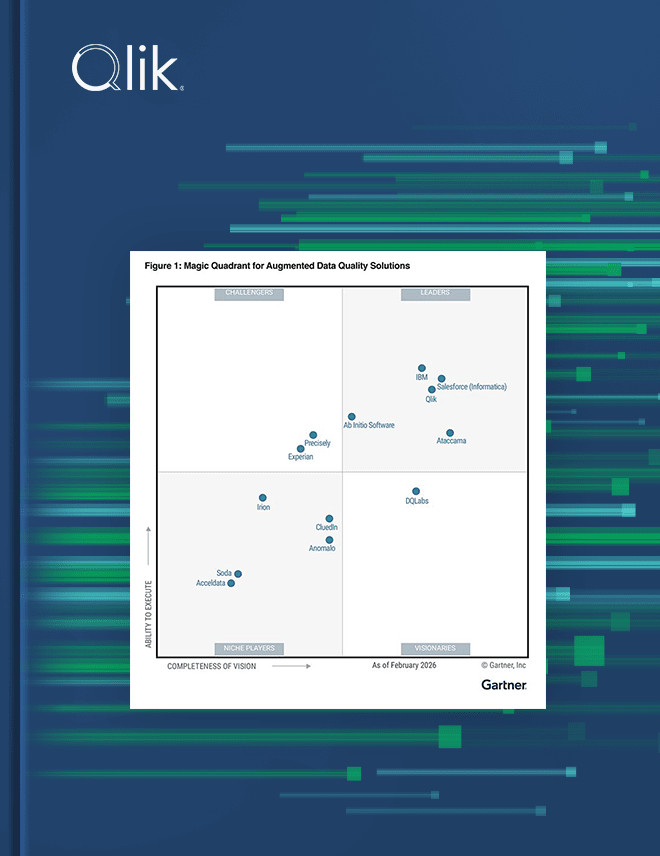
2026 Gartner® Magic Quadrant™ for Augmented Data Quality Solutions
See why Qlik® was named a Leader in the 2026 Gartner® Magic Quadrant™ for Augmented Data Quality Solutions for the seventh time.

Discover Qlik Talend Cloud’s Data Products
Grant consumers efficient access to data, confidence in its accuracy and relevance, and quicker time to actionable insights.

Find the right, domain-centric data fast
Shop the self-service data marketplace and use keyword search and filtering options to easily find the data products you need.

Get transparent, high-quality data
Increase user trust in the data with quality metrics, lineage, and user-access to profiling information.

Assess the impact of changes
Understand data sources, identify dependencies, and trace transformations with the lineage and impact analysis capability.

Turn data into actionable insights
Harness the power of familiar analytics tools like Qlik Cloud Analytics® to seamlessly consume data products and uncover meaningful business insights for domain-centric use cases. Empower teams to make confident, data-driven decisions quickly and effectively.

Increase accountability by defining clear ownership
Enable a Data Product Manager, and their domain expertise, to build data products from a catalog and define the product documentation, select relevant datasets, and assign ownership — enabling clear communication for development and question resolution.

Continuously develop data products
Own each product through domain-aligned data teams who manage the data product lifecycle, continuously updating and developing data products — ensuring they continue to generate business value.
From Datasets to Data Products
Examples of Data Products from popular data sources
Why it matters?
Reusable, domain-specific QVD-based data products to maximize efficiency. Control QVD sprawl and governance with ownership, lineage, and pull-up data quality. Bundle QVDs, scripts and model files in a data product to speed-up analytics app development.

Why it matters?
Turn Snowflake datasets into domain-specific, trusted data products to maximize value. Optimize data quality with Snowflake’s native push-down features – without moving data. Easily launch Qlik Sense analytics apps from Snowflake backed data products.

Why it matters?
Use pre-built analytics content and integrate data from SAP and other systems for multi-source insights. Transform SAP data into data products for use cases like Quote-to-Cash, and inventory. Get high-quality data insights to drive decision-making.

Take advantage of diverse, trustworthy, and discoverable data for GenAI development
Data products provide essential metadata and curated datasets that enhance RAG-based applications. Getting diverse, timely, accurate, secure, discoverable, and easily consumable data for machines from data product helps to guarantee that AI outcomes are relevant and reliable.

Frequently Asked Questions (FAQs)
A data product is a self-contained, reusable data asset designed, managed, and delivered with the same care as a commercial product. It packages the data with everything needed to use it reliably (documentation, quality standards, access rules, and clear ownership) and treats the people who consume it as customers. This product-thinking approach turns scattered, hard-to-trust data into dependable assets that others can easily find and reuse.
Data mesh is a decentralized way of organizing data, where ownership moves from a single central team to the individual business domains that know the data best. It's defined by four principles: domain-oriented ownership, treating data as a product, a self-serve data platform, and federated governance that applies consistent standards across domains. The aim is to cut bottlenecks and scale data work by putting responsibility closer to the people who create and understand the data.
"Data as a product" is a principle that data should be built and maintained with the discipline normally reserved for products people buy: defined owners, known users, quality guarantees, and ongoing support. It reframes data as something intentionally designed to serve its consumers, rather than a leftover byproduct of business systems. This mindset is a core idea behind data mesh and modern data management more broadly.
A dataset is a collection of data, such as a table of records, whereas a data product is that data made consumable: wrapped with documentation, quality checks, lineage, ownership, and access controls. The dataset is essentially raw material; the data product is a governed, ready-to-use offering built around it for a defined purpose. That added context and accountability is what makes a data product trustworthy and reusable across teams.
A widely used checklist describes good data products with the acronym DATSIS: discoverable, addressable, trustworthy, self-describing, interoperable, and secure. In plain terms, people should be able to find it, access it reliably, trust its accuracy, understand it without help, use it alongside other data, and know it's properly governed. A strong data product is also reusable, delivering value across many use cases rather than just one.
A data product owner is the person accountable for a data product throughout its life: defining what it includes, ensuring its quality, documenting it, and serving the people who rely on it. The role brings clear ownership to data that traditional pipelines often lack, giving consumers a single point of responsibility. Sometimes called a data product manager, this person balances users' needs with the effort to keep the product accurate and useful.
A data marketplace is an internal, self-service catalog where people across an organization can browse, search, and request access to available data products, much like shopping in an online store. It makes trusted data easy to discover and obtain without waiting on a central team, which speeds up how quickly people can put data to work. Well-run marketplaces pair discoverability with governance, so access is both convenient and controlled.
A data domain is a distinct area of the business (sales, finance, or supply chain) that owns and is responsible for the data it generates. Organizing data by domain is central to data mesh, based on the idea that the teams closest to the data understand it best and can maintain higher quality. Each domain curates and serves its own data, tailored to the outcomes that matter within that part of the business.
Data products give AI systems clean, governed, well-documented data along with the metadata that helps machines interpret it correctly, which is essential for reliable results. In retrieval-augmented generation (RAG), where a model pulls in external information to ground its answers, data products supply sources that are accurate, current, secure, and easy for machines to consume. This makes data products a practical foundation for building trustworthy AI applications.
Data product management is the practice of applying product-management discipline to data — treating data products as products with a defined purpose, users, lifecycle, and owner. A data product manager identifies consumer needs, defines what a data product should contain, oversees its quality and documentation, and guides it through development, release, and ongoing improvement. The goal is to ensure data products are genuinely useful, trustworthy, and continuously maintained, rather than built once and left to go stale.