
Accelerate SAP data integration
Make your live production SAP data available seamlessly across diverse platforms and hybrid environments. Streamline and improve SAP test data, and enable a wide range of SAP analytics use cases with this powerful and flexible data integration platform.


Unlock your SAP data and share across teams


Continuous real-time data ingestion
Stream data from SAP and non-SAP sources with real time updates available as they happen.

Structured and trusted data warehouses
Automate the entire data warehouse lifecycle from data modeling and real-time ingestion to data marts and governance.

Actionable insight and analytics
Qlik Cloud® Analytics offers AI-powered analytics that unlocks insights for all users without needing to know code or queries.
KEY RESOURCE
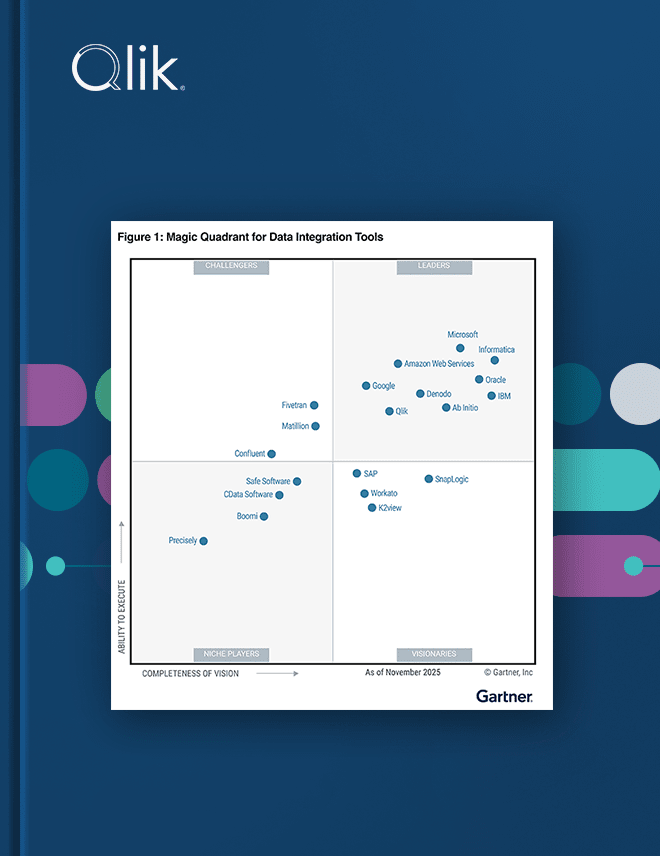
2025 Gartner® Magic Quadrant™ for Data Integration Tools
For the 10th consecutive year, Qlik was recognized as a Leader in the 2025 Gartner® Magic Quadrant™ for Data Integration Tools. Learn why in this complimentary report.

Uncover more insight with one-of-a-kind analytics for SAP
Let your users freely explore SAP data and combine it with sales, marketing, and other sources with Qlik Cloud Analytics. Powerful, flexible analytics helps make bigger, bolder discoveries. And with little or no IT support needed, everyone becomes more productive.

Combine SAP data with multiple sources, no matter how complex
Put your SAP data in the context of your entire business, by easily combining data sources into a single view, no matter how large or complex. The Qlik analytics engine indexes and understands the relationships between values in your data, letting you explore freely without limitations or blind spots.

Accelerate insights with AI-powered analytics
Empower everyone in your business with Qlik AI tools. Surface insights and suggestions so that users can easily explore to make new discoveries. This powerful approach to AI makes analytics more accessible to your entire workforce.


Go further, faster with proven SAP expertise
It takes skilled resources to ensure a solution is tailored to your unique environment and can meet expectations. Qlik Services has the SAP expertise necessary to best guide your organization, along with deep technology partnerships with major cloud vendors.

Frequently Asked Questions (FAQs)
SAP data integration is the process of connecting SAP systems like ECC, S/4HANA, and BW with other platforms so SAP data can be moved, combined, and used for analytics, AI, and reporting outside of SAP. It's challenging because SAP stores data in a complex structure that off-the-shelf tools struggle to read, which is why purpose-built solutions are used. A common modern approach is agentless, log-based extraction that moves SAP data to cloud and hybrid environments with minimal impact on the source system.
SAP data is hard to access because it's spread across tens of thousands of tables with cryptic technical names, and much of its business meaning lives in the application layer rather than the database, so reading the raw tables directly often loses context. SAP also uses specialized structures like cluster and pool tables, along with custom code and licensing considerations, that generic extraction tools can't interpret correctly. Tools that understand SAP's structures can extract meaningful, analytics-ready data without breaking that logic or straining the source system.
SAP S/4HANA is SAP's next-generation ERP suite, introduced in 2015, that runs exclusively on the SAP HANA in-memory database for real-time processing. It replaced the older SAP ECC with a dramatically simplified data model (such as the Universal Journal for finance), a modern Fiori user interface, and embedded real-time analytics. As organizations migrate to S/4HANA, many also want to combine its data with other sources for broader analytics.
SAP ECC is SAP's legacy ERP system that runs on various traditional databases (Oracle, SQL Server, DB2) with a complex, aggregate-heavy data model, while SAP S/4HANA is its modern successor that runs only on the SAP HANA in-memory database with a simplified data model, Fiori interface, and real-time analytics. The distinction matters urgently because SAP is ending mainstream support for ECC on December 31, 2027 (with paid extended maintenance to 2030), pushing most SAP customers to migrate. Because S/4HANA is a redesigned application rather than a simple upgrade, moving from ECC is a significant data and process undertaking.
SAP HANA is SAP's in-memory, columnar database that stores and processes data in RAM rather than on disk, enabling real-time analytics and transaction processing at very high speed. It's the foundation that SAP S/4HANA runs on: a common point of confusion, since HANA is the database while S/4HANA is the ERP application built on top of it. Its in-memory design is what lets S/4HANA combine transactional and analytical workloads in real time.
Extracting SAP data for analytics means getting data out of SAP's complex table structures and into a warehouse, lake, or BI tool in a usable form, a task complicated by SAP's application-layer logic and specialized table types. The most efficient modern approach is log-based change data capture, which reads changes directly and continuously without heavily loading the SAP system. This delivers SAP data in real time and in an analytics-ready form to platforms across the environment.
Real-time SAP replication uses change data capture (CDC) to identify and move only the data and metadata that change, as they change, keeping cloud targets continuously in sync with SAP. A log-based, agentless method is preferred because it reads changes with minimal impact on the SAP source and avoids heavy batch extracts. This non-intrusive approach can feed cloud data warehouses, lakes, and streaming platforms like Snowflake, Databricks, and Kafka.
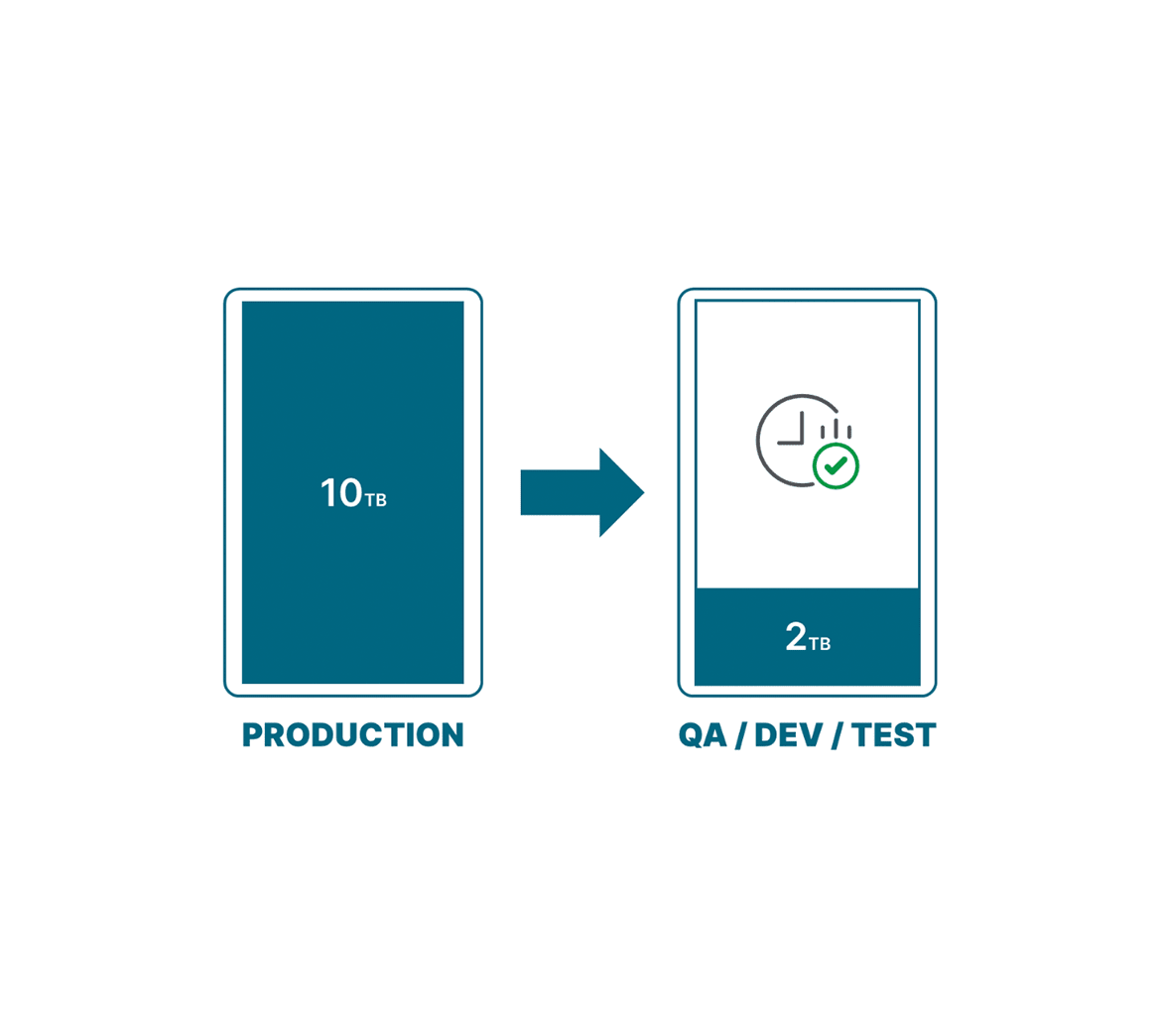
SAP test data management is the practice of creating and maintaining realistic, right-sized copies of SAP data for non-production environments like development, testing, and QA, without simply cloning entire massive production systems. Done well, it lets teams select precise data subsets, mask sensitive information for privacy and GDPR compliance, and dramatically shrink environment size and cost. For example, it can reduce a multi-terabyte production database to a much smaller test environment while preserving what's needed for realistic testing.
SAP data migration is the process of moving data between SAP systems or environments (most commonly from legacy ECC to S/4HANA, or from SAP into cloud platforms) while preserving accuracy, integrity, and compliance. It's a significant undertaking because of SAP's data volume and complexity, and it often involves data cleansing, masking, and careful selection of what to move. Choosing the right subset of data and validating it thoroughly are key to a successful migration.
SAP analytics is the practice of analyzing data from SAP systems to uncover business insights across finance, supply chain, sales, and other functions. A common challenge is that SAP data is often siloed and hard to combine with non-SAP sources using native tools alone, which limits the questions users can answer. Bringing SAP data together with other sources in an analytics platform allows richer, cross-functional analysis without heavy manual effort.


We needed to consolidate data in one place, from heterogeneous sources, updated in almost real-time. That’s what Qlik enables for us.


