DATA PREPARATION
Data Preparation: Transform Raw Data for Analytics, ML, and AI
Make sure that the last mile in your analytics journey is quick and easy and the data you’re using for analytics, machine learning and AI is ready fast!


Why data preparation is essential for analytics and ML
Data preparation with scripting capabilities
Faster insights.
Transform raw data into actionable intelligence in minutes. No app needed. Just load, script, and analyze.
Error-proof scripting.
Protect your work. Track changes, name versions, restore instantly. Collaborate with confidence.
Debug in seconds.
Test changes on the fly. No full reloads. Catch issues early, ship verified code.

Prepare data with drag-and-drop workflows
From raw to ready in minutes.
Drag, drop, analyze. No coding needed. Cut data prep time by 80%.
Anyone can prep data.
Break IT bottlenecks. Give your whole team confidence. Built-in guardrails keep data safe.
Tame data chaos.
Combine, clean, trust. Complex data, simple tools.

Easily prepare data for analysis
Prep in a snap
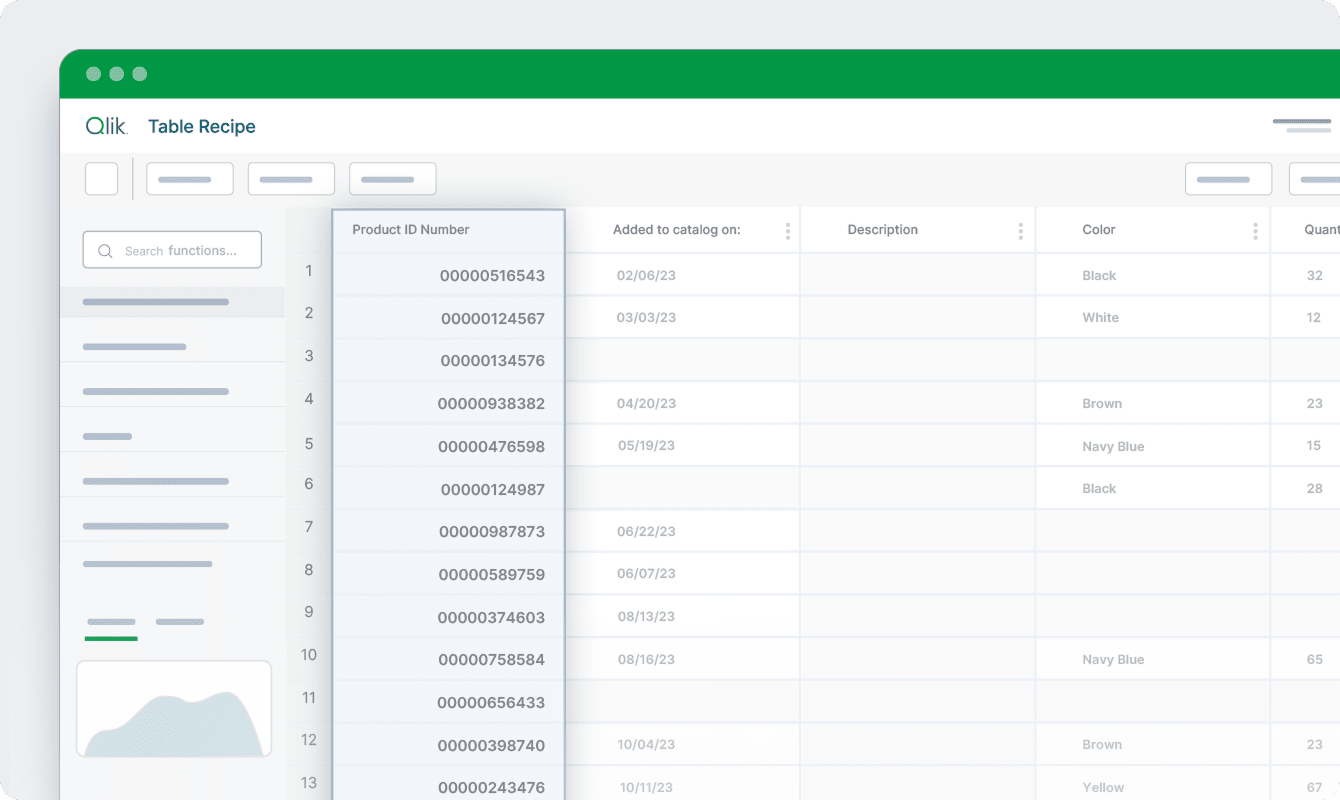
Clean data, fast. Prepare single-table datasets with nocode in a spreadsheet-like, interactive grid.
Single table, single focus
Familiar interface. Instant feedback. Get started quickly, without scripting, modeling, or complex flow-building.
Powerful simplicity
Get instant visual feedback as you work. Profile, filter, and track changes live, so your data is always ready to use.


Helping you work smarter, not harder.
All in one platform — Qlik Cloud Analytics®

Power to all - novice to pro
Flexible data prep for every skill level. Clean and shape data fast with a familiar spreadsheet feel—build your recipe, track steps instantly.

Visual drag-and-drop options
Start visual, combine and shape datasets—all in one place. Grow your data skills without switching tools.

Script mastery, made easy
Generate Qlik script through intuitive visual interface. Simplify complex tasks, boost your learning curve.
KEY RESOURCE
Data preparation best practices guide
Discover the secret ingredients for preparing clean,
analytics-ready data. Learn how Qlik’s data preparation tools let anyone seamlessly turn raw data into rich insights.


Data preparation use cases and examples
If you prepare data. We can help no matter what your use case is.
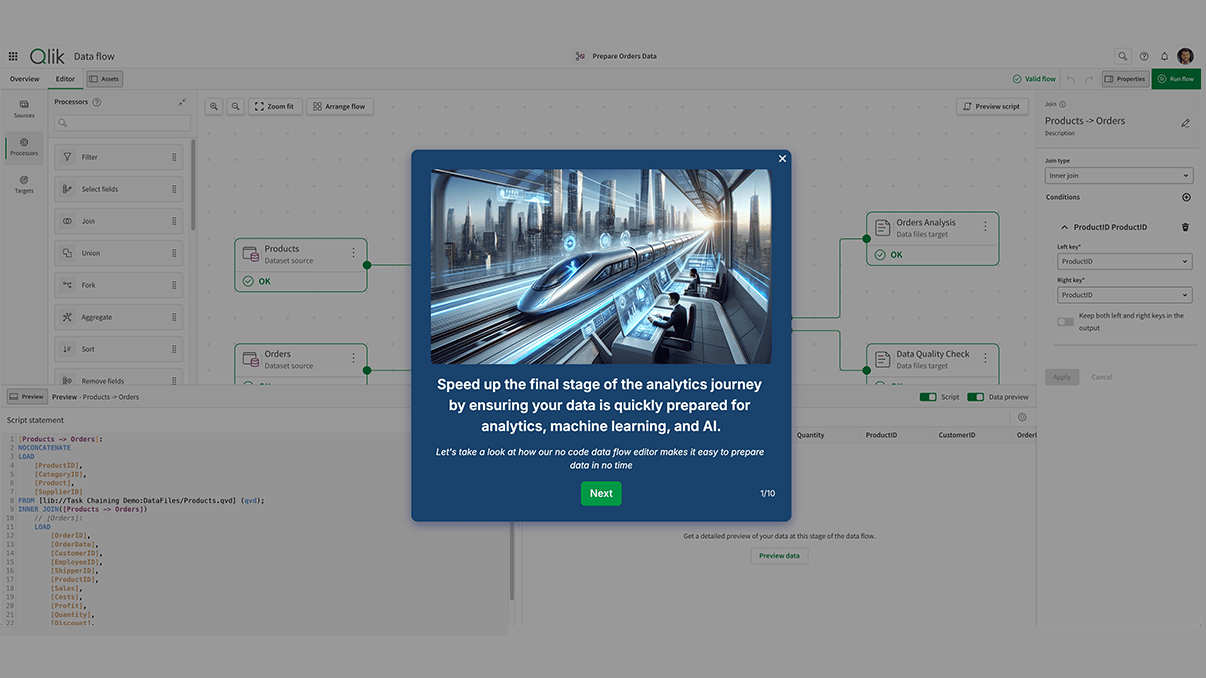
Table Recipe

Turn messy tables into clean, ready-to-use datasets. Build reusable recipes, making data prep fast and simple for all.
Frequently Asked Questions (FAQs)
Data preparation is the process of collecting, cleaning, combining, and shaping raw data into a form that's ready for analysis, reporting, machine learning, or AI. It typically includes fixing errors, standardizing formats, merging sources, and structuring the data correctly. It's often the most time-consuming part of any analytics project, often cited as taking up to 80% of a data team's effort.
Data cleansing (also called data cleaning) is the process of finding and correcting errors and inconsistencies in a dataset to improve its quality. It includes fixing inaccuracies, removing duplicates, handling missing values, and standardizing formats. Clean data is essential, because analysis, machine learning, and reporting are only as reliable as the data underneath them.
Data wrangling is the process of transforming and mapping raw, messy data into a clean, structured format suited to analysis. It emphasizes the hands-on work of cleaning, reshaping, combining, and enriching data, and the term is often used interchangeably with data preparation. It's also sometimes called data munging.
Data standardization is the process of converting data into a consistent format, structure, or set of values. It unifies things like date formats, units of measure, naming conventions, and address formats across different sources. Standardized data can be reliably compared, combined, and analyzed, which matters most when you're integrating data from multiple systems.
Data validation is the process of checking that data meets defined rules, formats, and quality criteria before it's used. Typical checks confirm that values fall within expected ranges, required fields are present, and data types are correct. Validating early catches errors before they flow downstream into reports, models, or decisions.
Data deduplication is the process of finding and removing duplicate records so each entity appears only once in a dataset. Duplicates commonly show up when data is combined from multiple sources or entered more than once. Removing them matters because duplicate records can inflate counts, skew metrics, and distort analysis.
Data preparation is the broad, end-to-end process of getting raw data ready for use: cleaning, combining, validating, enriching, and shaping it. Data transformation is one part of that process, specifically converting data from one format, structure, or set of values into another. In short, transformation is a component within the wider work of data preparation.
Data preparation software helps users collect, clean, combine, and shape raw data into a form that's ready for analysis, reporting, or machine learning. It typically provides tools to profile data for quality issues, fix errors and inconsistencies, standardize formats, merge data from multiple sources, and reshape or enrich it — often through a visual, no-code interface. By automating and simplifying these steps, the software reduces the manual effort that traditionally consumes much of a data project and lets more people prepare data without heavy coding.
A data platform is an integrated technology stack for storing, processing, managing, and analyzing data. The most widely used cloud data platforms include Snowflake, Databricks, Google BigQuery, Amazon Redshift, and Microsoft Azure Synapse/Fabric, each offering scalable storage and compute for analytics and AI. Organizations also rely on data lake storage services like Amazon S3, streaming platforms like Apache Kafka, and traditional relational databases, often combining several of these into a broader modern data architecture.