Build trust and drive usage of your data and analytics

Unified data quality and governance
Streamline data refinement into clean, compliant, and accessible assets.

Promote analytics and get deeper insights
Empower users with on-demand access to trusted, analytics ready data.

Quantify and measure trust
Build confidence in the reliability and accuracy of your data.
See how Qlik Talend Cloud
enables data quality and governance


KEY RESOURCE
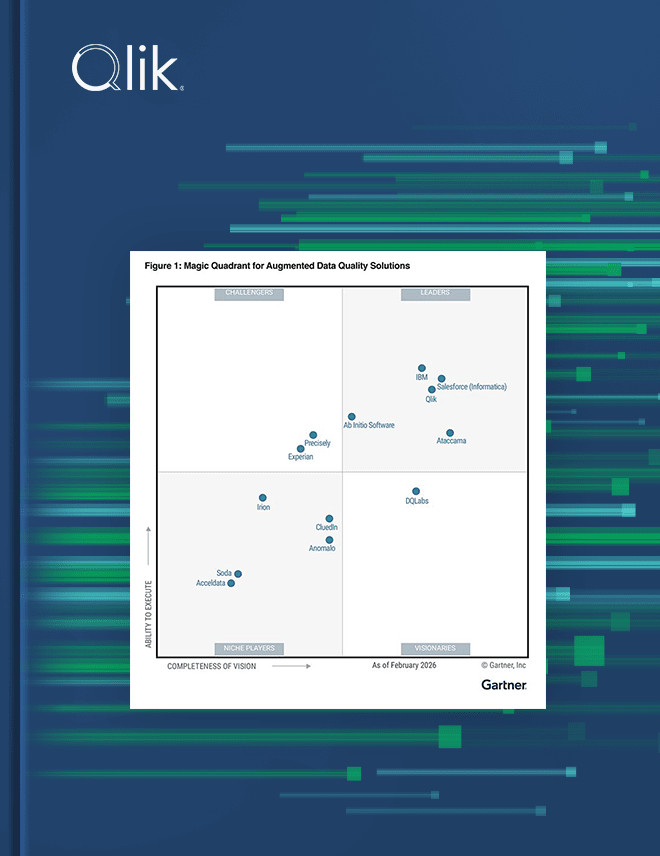
2026 Gartner® Magic Quadrant™ for Augmented Data Quality Solutions
See why Qlik was named a Leader in the 2026 Gartner® Magic Quadrant™ for Augmented Data Quality Solutions for the seventh time.

Strengthen data quality and governance
for trusted, AI-ready insights
Take a unified approach to data quality and governance
Modernize your cloud data infrastructure, ensure regulatory compliance, and develop your internal data marketplace with unified data quality and governance. Qlik Talend™ automated data profiling provides pervasive data quality rules, user-friendly tools, and harnesses the expertise of data stewards.

Boost analytics usage and generate deeper insights
A metadata-powered catalog helps you eliminate data silos, enforce consistency, and foster collaboration. You can discover, preview, and select content across all your datasets, apps, notes, business glossary terms, and other sources. Detailed insights help you fully understand — and utilize — your analytics pipelines.

Trust Your Data — For Business and AI Outcomes
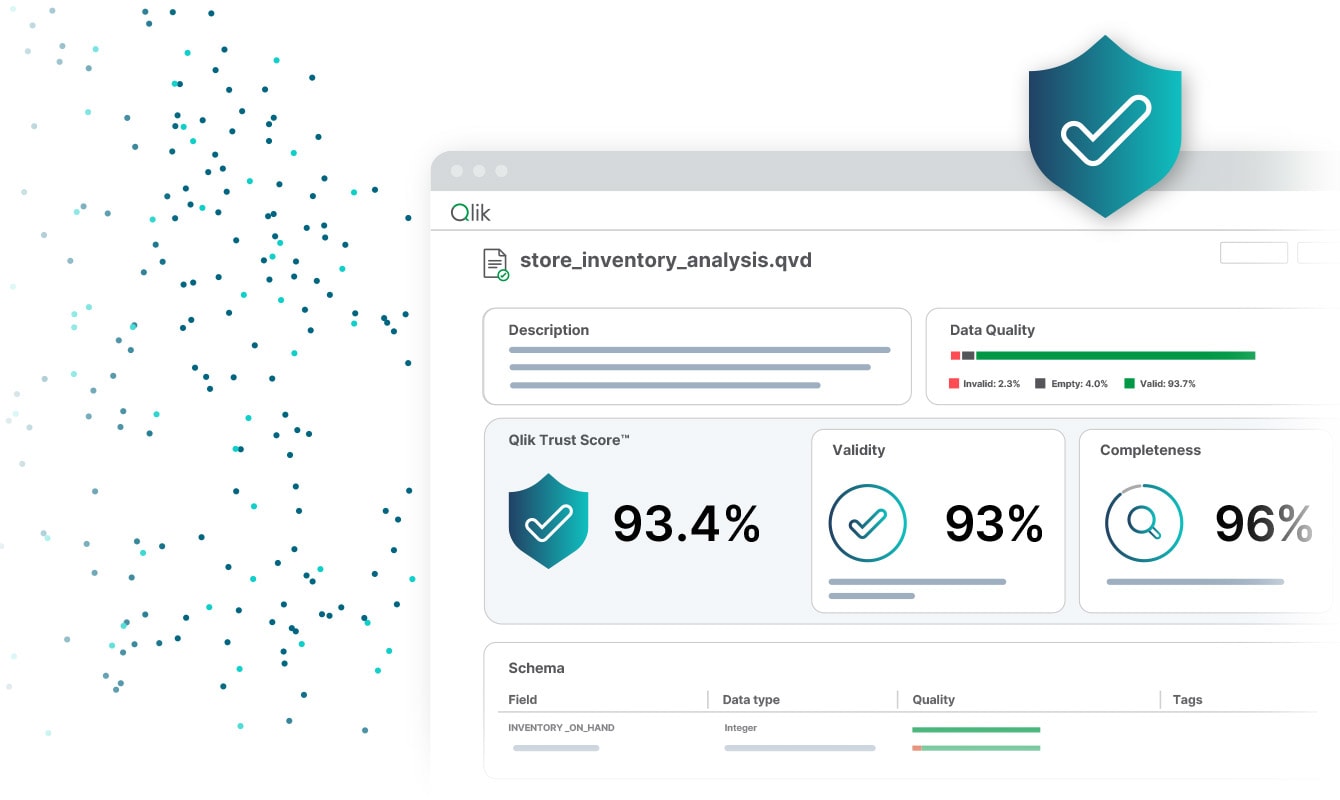
Qlik Trust Score™ removes the guesswork, giving you a clear, continuous view of data quality across key dimensions like completeness, usage, and discoverability. With tunable settings and support for both push-down and pull-up execution, it helps you to meet specific data quality needs and priorities. Qlik Trust Score™ for AI adds AI-ready metrics like accuracy, diversity, and timeliness — ensuring your data is reliable and ready for smart AI-driven decisions.
Data, Analytics, & AI Trends ’26
Get the trends-based, ROI-driving framework for rewiring your data, agents, and roles in Powering the Future of AI: Dare to Orchestrate Data, Agents, and Roles.
Frequently Asked Questions (FAQs)
Data governance is the framework of policies, roles, processes, and standards that keeps an organization's data accurate, secure, consistent, and used responsibly throughout its lifecycle. It defines who's accountable for data, how it's classified and accessed, and how quality and compliance are maintained, turning data into a trusted, well-managed asset rather than a liability. Effective governance typically unifies cataloging, quality, and stewardship.
Data quality describes the condition of the data itself (whether it's accurate, complete, consistent, and fit for use), while data governance is the broader framework of rules, roles, and processes that manages data across the organization. Put simply, quality is an outcome, and governance is the system that produces and sustains it, with quality being one of the things governance is responsible for. The two work best together, so quality is enforced within a governed framework rather than as a separate effort.
Data quality is typically measured across several dimensions: accuracy (does it reflect reality), completeness (is anything missing), consistency (does it agree across systems), timeliness (is it current), validity (does it conform to rules and formats), and uniqueness (are there duplicates). For AI use cases, extra dimensions like diversity and representativeness matter too. Evaluating data against these dimensions gives a continuous, measurable view of its quality.
Data profiling is the process of examining data to understand its structure, content, and quality, analyzing patterns, value distributions, null rates, formats, and anomalies to reveal problems before the data is used. It's usually the first step in any data quality effort, because you can't fix issues you haven't found. Automated profiling can surface quality issues and help generate the rules needed to fix them.
Data stewardship is the practice of actively managing and overseeing data assets to keep them accurate, consistent, compliant, and fit for use. A data steward curates and validates data, applies quality rules, resolves issues, and serves as the human point of accountability for a given data domain, bridging business context and technical management. Good stewardship combines human judgment with self-service tools to profile, correct, and certify data within a governed workflow.
Data quality is measured by assessing data against its key dimensions (accuracy, completeness, consistency, timeliness, validity, and uniqueness) and expressing the results as scores or metrics that can be monitored over time. Effective measurement is continuous rather than one-time, so teams can track trends and catch degradation early. For AI use cases, extra metrics like diversity and representativeness are increasingly tracked alongside the traditional dimensions.
Master data management (MDM) is the discipline of creating and maintaining a single, authoritative record for an organization's core business entities (customers, products, or suppliers) so every system references the same trusted version. It relies heavily on data quality techniques like matching, linking, and merging to reconcile duplicates and conflicting records across sources. Reliable master data cuts inconsistencies and gives the whole organization a common point of reference.
Data governance supports compliance by giving organizations the controls to meet regulations like GDPR, HIPAA, and CCPA: data classification, access controls, lineage, retention policies, and protection of sensitive information. Because governance documents where data came from and how it's used, it makes audits and regulatory reporting far easier and cuts the risk of costly violations. Building these controls into everyday data handling means compliance is maintained by design rather than bolted on.
Augmented data quality (ADQ) is a category of AI-enhanced data quality solutions that automate traditionally manual work: using machine learning and active metadata to profile data, discover and generate quality rules, detect anomalies, and recommend or apply fixes. Gartner defines it as capabilities that streamline issue identification, offer context-aware corrective suggestions, and automate key data-quality processes. It's become a fast-growing market as AI raises the stakes for trusted data.
A data governance framework is the structured set of policies, roles, processes, and standards that defines how an organization manages, protects, and uses its data throughout its lifecycle. It clarifies who is accountable for data (such as owners and stewards), how quality and security are maintained, and how compliance and access are enforced. A well-designed framework turns governance from ad hoc effort into a repeatable, organization-wide practice that keeps data trustworthy and well-managed.
Data governance policies are the formal rules that specify how data should be handled, protected, and used across an organization. They typically cover areas like data access and security, privacy and regulatory compliance, data quality standards, retention and disposal, and the roles and responsibilities for managing data. These policies translate governance principles into concrete, enforceable guidelines, giving everyone a consistent basis for how data is treated day to day.


