TRUSTED INTELLIGENCE FROM QLIK, FOR ALL AI
The Doorway Between AI and Trusted Intelligence
Qlik® MCP server flexibly connects all your AI to trusted data and powerful analytics — enabling more reliable insights, faster decisions, and smarter automation.
LEARN MORE ABOUT MCP
Connect AI to Qlik for trusted data and
game changing analytics
A simple, open way to connect all your AI to trusted Qlik intelligence
Qlik’s MCP server makes it easy to bring AI together with Qlik’s trusted data products and analytics engine – so AI can reason with real business context wherever you work.
Use Qlik’s MCP server to bring Qlik intelligence into your AI platform of choice. MCP ensures AI works with governed data and delivers accurate, context-aware insights – without complexity or compromise.

Seamless interoperability for analytics and real decisions
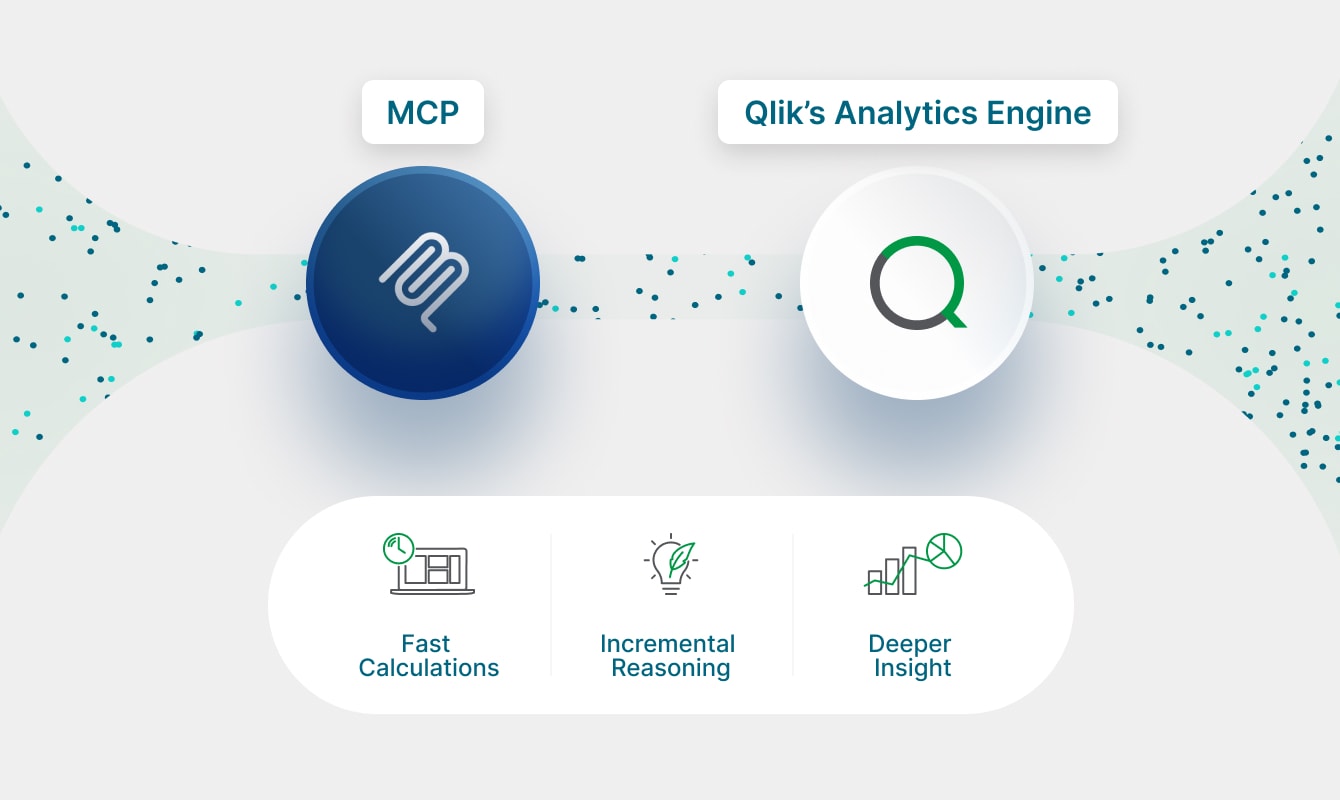
Qlik’s MCP server provides a flexible integration layer that lets AI use Qlik’s analytics engine for fast calculations, incremental reasoning, and deeper insight. Instead of stitching together SQL queries or relying on language models to infer calculations, MCP lets AI use Qlik to “do the math”– clearly and at scale. This makes it easy to explore data, understand outcomes, and drive efficient workflows, all through a single set of tools.
QLIK MCP DATASHEET
Qlik MCP Server: The Doorway Between AI and Trusted Intelligence
Connect Qlik's trusted, governed data and powerful analytics engine to any AI assistant of your choice — delivering advanced reasoning and insight with speed, scale and cost efficiency.


Use trusted intelligence across any AI ecosystem
By exposing its governed data, analytics engine, and APIs through the Qlik MCP server, Qlik gives you trusted intelligence wherever it adds the most value. The result is faster insight, lower cost, and the flexibility to scale AI on your terms — without being locked into a single platform or approach.

Frequently Asked Questions (FAQs)
An MCP server is a program that exposes specific capabilities — such as access to a database, a file system, an API, or an analytics engine — to AI applications through the Model Context Protocol. It advertises what it can do in a standardized way, so any MCP-compatible AI client can discover and use those capabilities without custom integration code. Organizations build or deploy MCP servers to give AI safe, governed access to their own tools and data.
In MCP, the host is the AI application the user interacts with — such as a desktop assistant, an IDE copilot, or a custom agent — and the client is the connector inside that host which maintains a dedicated, one-to-one session with a single MCP server. A single host can maintain multiple client connections to different servers, giving the AI a unified set of tools and data across many sources. Together, the host and its clients handle discovering capabilities, sending requests, and routing responses.
MCP uses a client-server architecture built on JSON-RPC, a lightweight standard for exchanging structured messages. When an AI host connects to an MCP server, the two negotiate capabilities, and the server tells the client which tools and data it offers, so the AI can call those capabilities as needed during a task. Connections can run locally as a subprocess or remotely over HTTP, which lets the same approach work for both desktop apps and cloud services.
These are the three core capabilities an MCP server can expose. Tools are functions the model can invoke (such as database queries or API calls), resources are data sources the model can read, and prompts are pre-defined templates that guide workflows. By standardizing these building blocks, MCP lets any compatible AI application understand and use a server's capabilities consistently.
A traditional API defines how two specific software systems exchange data, and each API tends to have its own unique design that developers must learn and integrate individually. MCP sits at a higher level: it's a standard way to expose capabilities — which may themselves wrap underlying APIs — so AI applications can discover and use them uniformly. In short, APIs connect particular systems to each other, while MCP provides a consistent interface for AI to reach many tools and data sources at once.
Function calling (or tool use) is the underlying mechanism by which a language model decides to invoke an external function and supplies the arguments. MCP does not replace function calling — it standardizes it, defining a universal, discoverable way to describe tools, authenticate, and connect so the same tools work across different AI applications. Put simply, function calling is how a model triggers a tool, while MCP is how that tool is consistently exposed and made available to any compatible model.
AI agents need to interact with the outside world — reading data, calling services, and taking actions — to accomplish multi-step goals, and MCP gives them a standard way to do it. Instead of hard-coding each connection, an agent can use MCP to discover and use whatever tools and data its host has connected, then combine them as the task requires. This makes MCP a common integration layer for building agents that work reliably across many systems.
MCP is an open-source, open standard introduced by Anthropic in November 2024. It was designed to be vendor-neutral, and in December 2025 Anthropic donated MCP to the Linux Foundation's Agentic AI Foundation, cementing it as a vendor-neutral industry standard. Major AI providers and a large ecosystem of tools have adopted it, which is part of why it works across different AI platforms.
Because MCP lets AI applications access real tools and data — and take actions — securing those connections is essential. Key considerations include strong authentication and authorization (modern MCP uses OAuth 2.1 authentication for remote servers), limiting each server's access to only what's necessary, and validating and monitoring the actions AI is permitted to perform. Treating MCP servers as governed entry points to sensitive systems, with clear access controls and auditing, helps keep AI use safe and compliant.
RAG focuses on retrieving information to feed into the model's prompt, while MCP enables both retrieval and action — the model can read data and write data through the same protocol. Framed simply, RAG makes a model more knowledgeable, whereas MCP makes it more capable. The two are complementary: an AI system can use MCP to connect to sources and still apply RAG techniques to ground its responses.