SEE CRITICAL CHANGES AS SOON AS THEY HAPPEN
Discovery Agent Tracks What’s Changed
Discovery Agent is Qlik’s AI-driven anomaly and outlier detection agent that monitors your Qlik apps, detects meaningful shifts in your data, and delivers clear, prioritized insights so teams can act before issues escalate.
Dashboards require you to look for anomalies, Discovery Agent pushes them to you.
Dashboards lag. Alerts miss. You fall behind.
Critical changes go unnoticed until they’re costly
Gradual shifts and new baselines never trigger alerts
Analysts spend hours checking dashboards
SQL-based monitoring breaks under scale
You need a system that’s always on, watching the data, and deciding what truly matters.
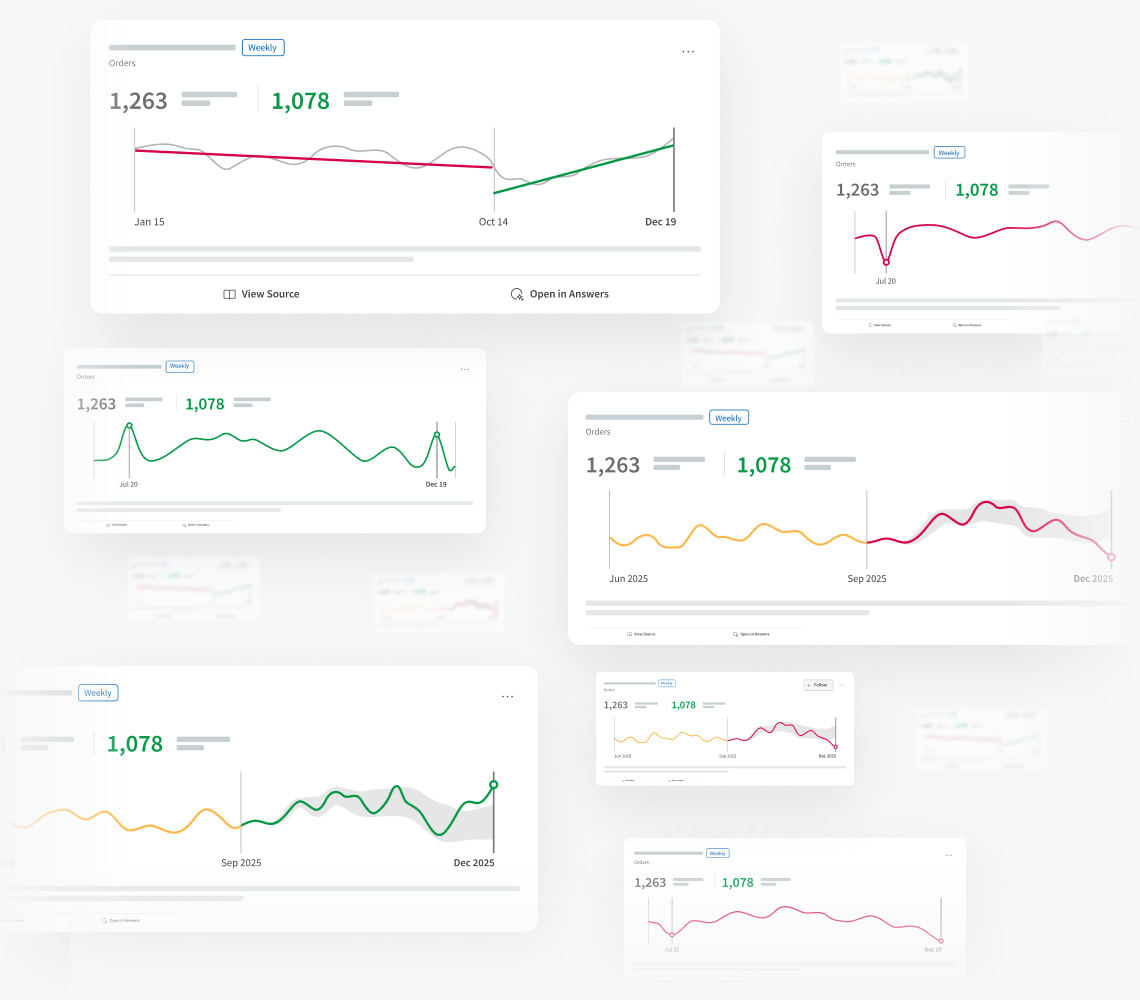
Engine-powered anomaly detection at enterprise scale
Discovery Agent runs on the Qlik Analytics Engine, evaluating complex data without heavy SQL or query design. It can:
Analyze data using associative technology with high dimensionality
Run across large data sets without inflating compute costs
Consider full context instead of one metric at a time
It’s anomaly detection that’s both statistically smart and practical at scale.

Never miss an important signal again
Eliminate manual monitoring

Let AI do the heavy lifting
Replace manual KPI checks and SQL scripts with automated, engine-powered scanning.
Scale your monitoring
Watch everything without lifting a finger.
Enable anomaly detection across many apps.
Improve trust in your data
Spot bad data before it causes bad decisions
Automatically flag missing or inconsistent data, so decisions rest on solid ground.
Built for leaders and analysts who can’t afford surprises
Business leaders want to see what changed — no dashboards required. Analysts want less grunt work and more time for real analysis. Data leaders need scalable, reliable change detection without building custom monitoring logic or managing alert fatigue.
Keep an eye on:
Spikes in cancellations or returns, drops in service levels or delivery rates, or shifts in backlog or utilization.

Watch for:
Unexpected swings in revenue, margin, or cost centers. Look for cash flow or aging pattern deviations or outliers in pricing or expenses.

Automatically detect:
Changes in usage or engagement, new baselines for churn or support volume, and anomalies in key product flows.

Watch for:
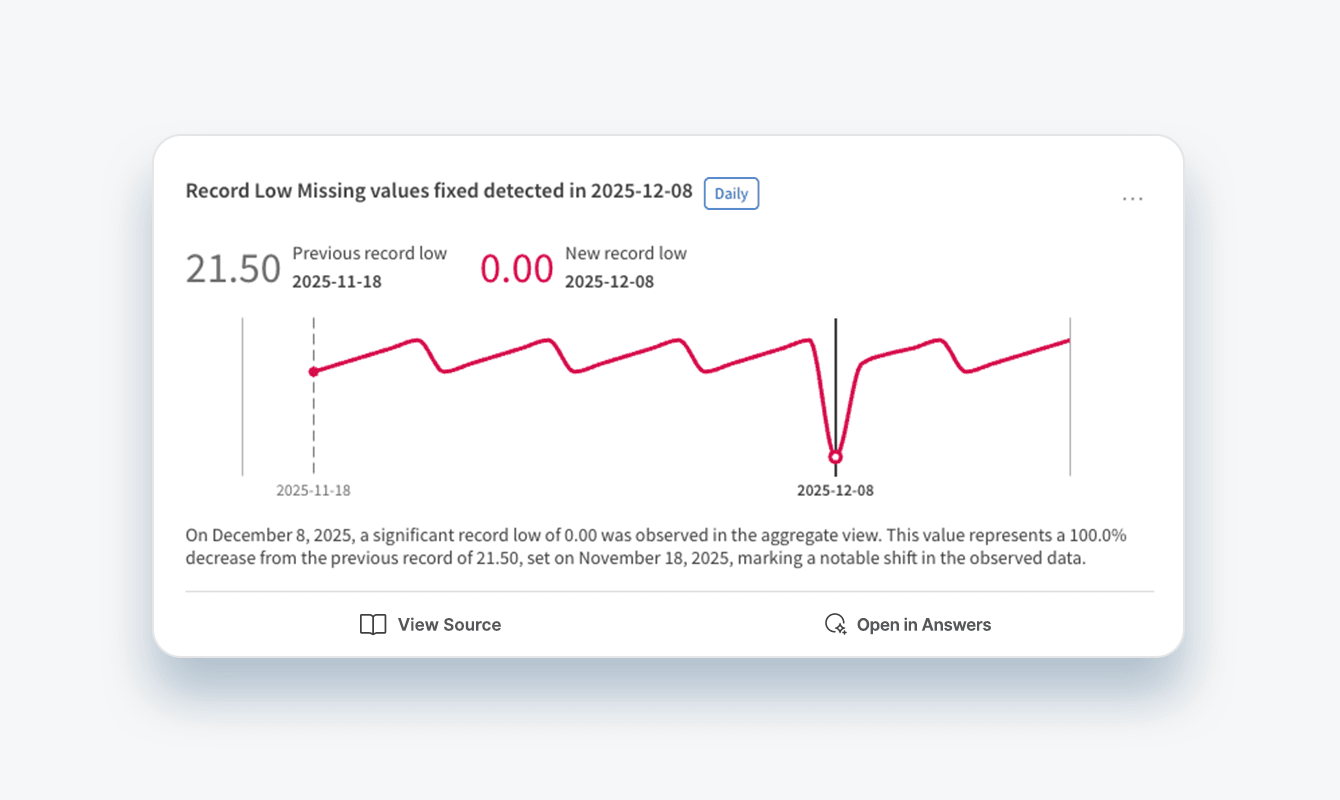
Gaps in source data, shifts in value distributions or codes, and metrics behaving differently from the past.
Frequently Asked Questions (FAQs)
Machine learning anomaly detection works by learning what normal looks like in a dataset (the typical values, ranges, and patterns) and then flagging anything that deviates meaningfully from that baseline. Anomalies generally fall into three kinds: point anomalies (a single unusual value), contextual anomalies (a value that's only unusual in a particular context, like a spike at an odd time), and collective anomalies (a group of readings that together signal something off). Automating this at scale lets organizations surface important shifts continuously, rather than relying on people to catch them by manually reviewing reports.
An outlier is a data point that sits far from the rest of the data: a statistical description of something unusually high or low. An anomaly is a broader idea, any data point, event, or pattern that departs from expected behavior, which can include outliers but also unusual sequences or context-dependent deviations. In practice, "outlier" tends to describe the raw statistical oddity, while "anomaly" implies the deviation may be meaningful and worth investigating.
Proactive analytics is an approach where analytics systems actively monitor data and surface relevant insights, risks, or opportunities on their own, pushing them to users instead of waiting for someone to go look. It contrasts with reactive analytics, where people must open dashboards and run queries to find out what changed. The goal is to catch important developments early, before they show up in a report or grow into a costly problem.
Data monitoring is the continuous, often automated tracking of data (its values, quality, and behavior) to catch issues or changes as they happen. Rather than checking data periodically, monitoring keeps a constant watch, so anomalies, errors, or unexpected shifts get caught and addressed promptly. It's widely used to protect data reliability and keep operations, finance, and customer metrics under ongoing observation.
Data drift is a change over time in the statistical properties or distribution of data compared with an earlier period or an established baseline. It often reflects shifting real-world conditions (changing customer behavior or new market dynamics) and can quietly undermine analytics and machine learning models built on the old patterns. Detecting drift early helps teams recognize when their data, and the decisions based on it, may no longer reflect reality.
Trend analysis is the practice of examining data over time to identify consistent patterns or directions of change, such as steady growth, decline, or recurring seasonality. It helps organizations understand not just what a value is at one moment, but how it's moving and why. These insights support forecasting and planning, and a break in an established trend can itself be an important signal worth investigating.
A baseline is a reference point or expected normal range drawn from historical data, used as a benchmark for comparison. New data is measured against it to judge whether current values are normal or represent a meaningful change. Baselines are central to anomaly detection, because flagging a deviation first requires a clear, data-driven definition of "normal" (one that may itself shift as conditions evolve).
Root cause analysis is a problem-solving approach for finding the underlying reason an issue or anomaly occurred, rather than just addressing its visible symptoms. By tracing a problem back to its true source, teams can fix it at the origin and reduce the chance it recurs. In analytics, it often follows the detection of an anomaly: once an unusual change is spotted, root cause analysis helps explain why it happened.
Data alerting is the automated notification of users when data meets defined conditions (a metric crossing a threshold or an anomaly being detected), so people can respond quickly. It helps teams stay aware of important changes without constantly watching dashboards. One limit of simple threshold-based alerts is that they can miss gradual shifts or changes that only matter in a specific context, which is why more advanced detection methods often run alongside them.
An AI agent is a software system designed to operate with a degree of autonomy: perceiving data or its environment, deciding what matters, and acting on it, often continuously and without waiting for a prompt. That makes it different from tools that only respond when a user asks a question, since an agent can keep watch and take initiative within set boundaries. Agents are frequently built for specific jobs, like monitoring data streams, detecting changes, and prioritizing what a human needs to see.
Start seeing what’s changing as soon as it changes
Discover how Discovery Agent helps your teams stay ahead of risks and opportunities — without adding more dashboards or manual checks.