DATA ACCESS GOVERNANCE SOLUTION
Protect and Control Your Data with Qlik's Data Access Governance Solution
Control and protect your data with comprehensive access governance. Manage permissions, enforce policies, and ensure compliance across your data ecosystem with centralized security.
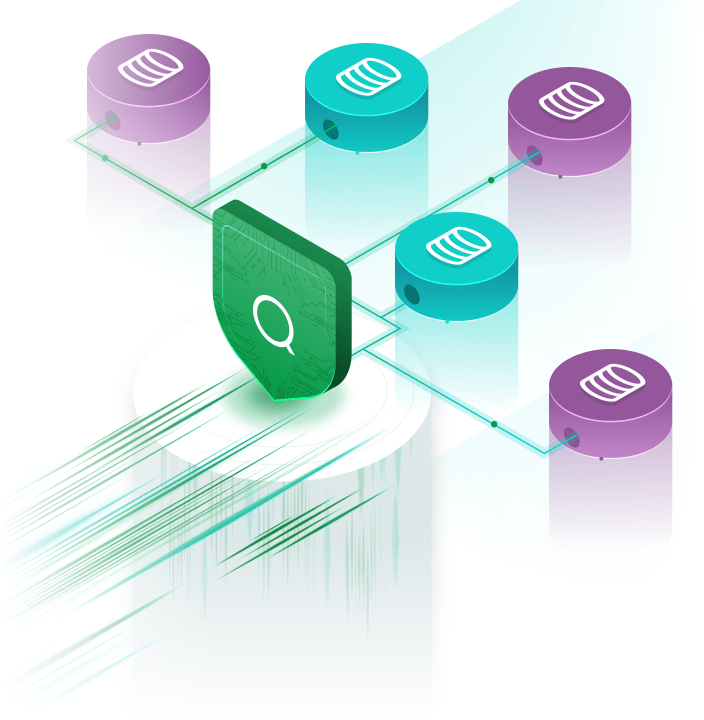
Enforce compliance and data trust across your organization
Establish comprehensive access controls that protect sensitive data while enabling appropriate access for analytics and operations, balancing security requirements with business productivity needs.

Define and manage access policies centrally
Create and maintain access policies in one location that propagate automatically across all data assets, eliminating policy fragmentation and ensuring consistent security enforcement.

Control permissions across cloud and on-premise environments
Apply unified access controls across diverse infrastructure including public clouds, private data centers, and hybrid architectures with consistent policy enforcement everywhere.

Empower secure collaboration with governed data sharing
Enable safe data sharing within and across organizational boundaries with granular controls that protect sensitive information while facilitating necessary collaboration and analysis.
How Qlik's Data Access Governance Solution works
Step 1 - Discover and classify sensitive and regulated data
Step 2 - Define user roles, access levels, and data policies
Step 3 - Automate policy enforcement and permission updates
Step 4 - Audit and monitor data usage across the enterprise

Why choose Qlik for data access governance
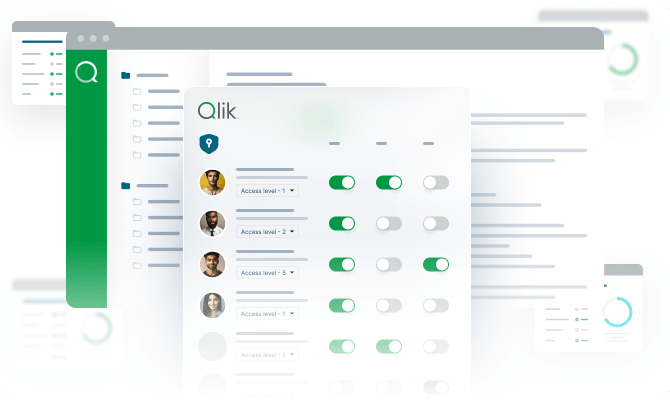
One platform for all access governance needs
Simplify security administration with centralized platform that manages permissions, policies, and access controls across all data assets from a single interface.

Governance that extends everywhere
Apply consistent access controls across Qlik platforms and external systems including data warehouses, lakes, and applications through native integrations and standard protocols.

Meet regulatory requirements automatically
Support GDPR, HIPAA, SOC 2, and other regulatory requirements with automated controls, audit trails, and privacy protections that demonstrate compliance during audits.

Governance that business users understand
Enable data stewards to define business-oriented access policies through intuitive interfaces while IT maintains technical controls and security enforcement mechanisms.

Enterprise-proven security and governance
Join organizations that protect sensitive customer, financial, and operational data with Qlik's governance, ensuring security without sacrificing analytics accessibility.
Key capabilities of Qlik's Data Access Governance Solution

Policy-based data access management
Define access policies using business rules that automatically determine permissions based on user attributes, data sensitivity, and context, eliminating manual permission management.

Role-based access control and audit trails
Assign permissions based on organizational roles with inheritance hierarchies that simplify administration while maintaining comprehensive logs of all access attempts and changes.

Automated permission updates and notifications
Synchronize permissions automatically when organizational changes occur, notifying affected users and administrators while ensuring access remains appropriate for current responsibilities.

Integration with authentication and identity systems
Connect with Active Directory, LDAP, OAuth, and identity providers to leverage existing user management infrastructure and enable single sign-on with consistent security.

Scalable architecture for complex data environments
Manage access across thousands of data assets and users with performance that maintains consistent policy evaluation speed regardless of environment complexity.

Security and governance for analytics and AI workflows
Extend access controls to analytics platforms and AI applications, ensuring model training and inference respect data privacy policies and regulatory constraints.
Trusted by leading enterprises worldwide


What our customers say


We needed to consolidate data in one place, from heterogeneous sources, updated in almost real-time. That’s what Qlik enables for us.


Connect to 500+ data sources with Qlik’s analytics integrations

SAP

Adobe

IBM

AWS

MySQL

Jira

Azure

MS SQL

Apache

Mongo DB
SAP
Adobe
IBM
AWS
MySQL
Jira
Azure
MS SQL
Apache
Mongo DB
SAP
Adobe
IBM
AWS
MySQL
Jira
Azure
MS SQL
Apache
Mongo DB
SAP
Adobe
IBM
AWS
MySQL
Jira
Azure
MS SQL
Apache
Mongo DB
SAP
Adobe
IBM
AWS
MySQL
Jira
Azure
MS SQL
Apache
Mongo DB

Oracle

Salesforce

Workday

Apache Iceberg

CircleCI

Zendesk

Snowflake

Databricks


OpenAI

Intuit
Oracle
Salesforce
Workday
Apache Iceberg
CircleCI
Zendesk
Snowflake
Databricks
OpenAI
Intuit
Oracle
Salesforce
Workday
Apache Iceberg
CircleCI
Zendesk
Snowflake
Databricks
OpenAI
Intuit
Oracle
Salesforce
Workday
Apache Iceberg
CircleCI
Zendesk
Snowflake
Databricks
OpenAI
Intuit
Oracle
Salesforce
Workday
Apache Iceberg
CircleCI
Zendesk
Snowflake
Databricks
OpenAI
Intuit
Resources


Data Access Governance Solution FAQs
Policies define access rules using business logic that automatically determines permissions based on context, eliminating manual administration and ensuring consistent security enforcement.
Yes, context-aware policies evaluate user attributes, data sensitivity, time, location, and other factors dynamically to grant appropriate access for each request.
Temporary access grants, partner-specific policies, and data masking enable controlled sharing with external users while protecting sensitive information and maintaining audit visibility.
Automated workflows detect role changes, update permissions accordingly, and notify administrators while ensuring users maintain necessary access during transitions.