







In 2023, the EU introduced measures to ensure there will be focus on the gender pay gap and at the same time strengthen employee rights, especially for companies that have more than 100 employees. For businesses and specifically HR Professionals, this directive coming into force in the mid-point of 2026 creates several challenges that require both operational and strategic responses.
Pay Transparency and Reporting
Although we see transparency enforced in several states in the USA already, much of the EU as yet has not had to consider publicly broadcasting pay ranges for advertised roles. From both a strategic and tactical perspective this on its own has the ability to be quite a headache – unless you already have established pay, and pay grade practices.
For the smaller companies, who do not yet have the scale to invest in these pay practices and employee classifications, reporting will be challenging and initially, likely a heavy lift.
Ironically, larger businesses that already have the structure in place could see an equally big exercise in evaluating the workforce to ensure any anomalies are identified and addressed correctly.
Data Collection and Accuracy
For all companies that will now have this exercise on their agenda, the need will be for both robust and reliable HR and payroll systems to capture, structure, and analyze compensation data across roles, levels, and locations. Adding to the complexity of this activity, it must also be repeatable, as reporting out on a cadence, and ongoing maintenance of fair pay practices will be here to stay.
Job Evaluation and Classification
The challenge of aligning different job structures, titles, and grading systems for fair comparisons, should not be underestimated and can quickly become a significant and unwieldy data set to keep track of. Further, the directive explains that comparisons should be made for “work of equal value”, not just job titles, many companies will lack the standardized frameworks to evaluate jobs consistently, generating the opportunity for unequal evaluations and ongoing employee relations issues relative compensation.
Remediation of Pay Gaps
The bottom line here is that if a pay gap of ≥5% is found and cannot be justified, corrective measures are mandatory. Given we are closing out 2025 currently and new budgets and spend regimens are coming shortly for 2026, many companies may find themselves with a varying level of unplanned or additional compensation commitment – and for many of us, in already dynamic and challenging times.
Where does People Analytics come in?
Using Qlik for this exercise can address and accelerate your analysis, and give you actionable insights very quickly. With the right tool, it can also be used as an ongoing safety-net during any hiring activity to avoid any pay disparity before a new worker even enters your business.
From identifying the data, through a repeatable load sequence that ensures consistency, Qlik Sense can deliver an accurate picture of your workforce ‘on demand’ and if/when connected to your hiring activity can also alert you to potential issues before they arise. Getting to this work now may also prevent any unwanted surprise oncosts for compensation adjustments that could be mandated by law, and definitely prevent any legal proceedings or employee grievances.
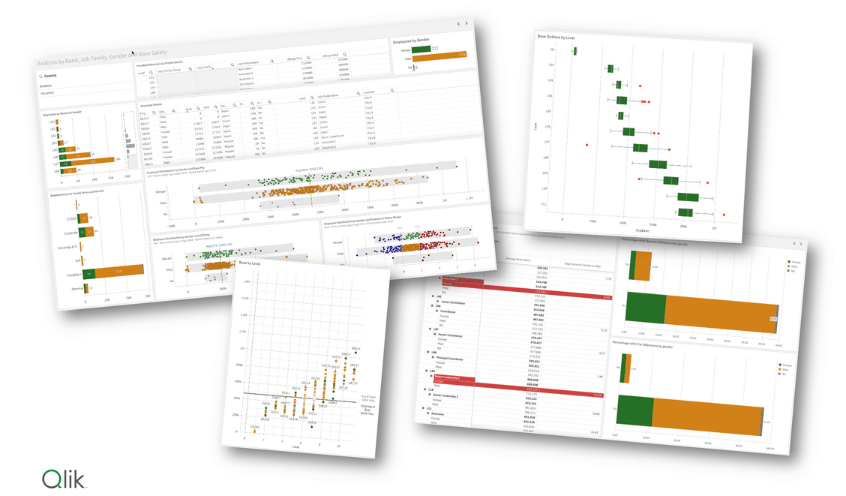
If you are an existing Qlik customer, and would like to receive a demo copy of the tool we have developed in-house, we would be delighted to hear from you – our Sales Team are ready help you provide a copy and some guidance to get you up and running.
In this article:
Analytics