







How Qlik Answers Unlocks Generative AI for HR

Human Resources is rich in data but often struggles to make it accessible and actionable. As a profession we also live in the ‘grey’ – of course recognizing that People are by very definition different, unique and often require individual approach. Much of the employee lifecycle, now being digital, has meant the rise and relevance of People Analytics has grown hugely in the last few years, but there is still a huge amount of untapped potential in the unstructured data created by, as well as consumed by the workforce.
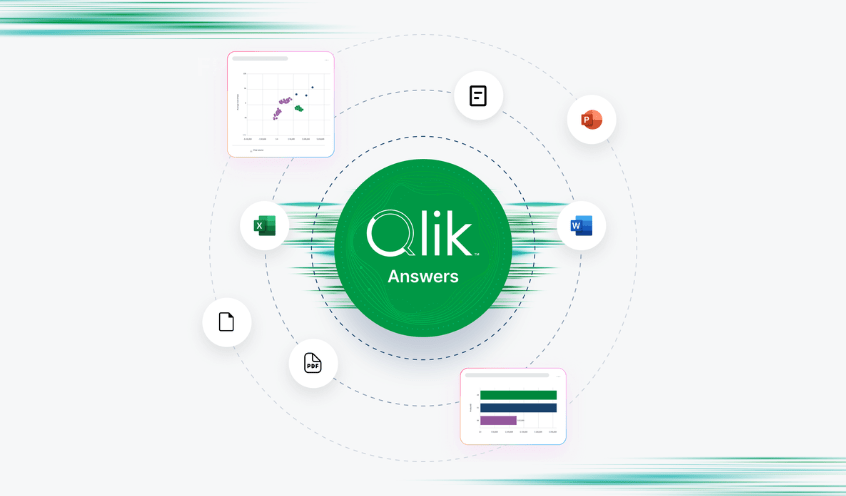
Qlik Answers - our generative AI solution - changes this by allowing HR teams, managers, and employees to ask questions in plain language and receive clear, contextual insights instantly.
This makes HR more agile, proactive, and impactful form strategic business planning, through tactical execution, as well as every aspect of the employee lifecycle, though there are pitfalls, discussed later. In short, at minimum impact, Qlik Answers is a game-changer.
I keep hearing the statistic (exact percentages vary) that AI implementations are failing, and the investment being made is falling far short of the expected return. Of course, we all have to start somewhere, so I put our best foot forward with 3 implementations that are driving efficiency and speed here at Qlik, with more, much more, exciting implementations coming in the next few months – more of that in another post later-
Let’s look at where we are seeing success:
Initially we have focused on our unstructured datasets, and have developed some hugely helpful tools that have been able to accelerate our time to insights within the HR Function here at Qlik, there included:
Employee Survey, sentiment analysis
HR ‘All Hands’ meetings.
Ask Adam.. our Eightfold implementation partner.
In each use-case we have created and indexed a set of documents to create a Knowledge Base, and connected this to a front-end, user facing assistant. This process is alarmingly straightforward meaning your time to insights – depending on the size of your documentation set – can truly be minutes, getting you to a conversational interaction with your data very quickly.
Let’s look a little deeper at each use case to understand what we are doing and the value we are bringing to the organization:
Employee Survey, sentiment analysis
Use Case: For each round of our semi-annual Employee Engagement survey (delivered through Peakon), we see somewhere between 8,000 to 10,000 comments – no question that our employees are engaged which is amazing to see.
While each leader has a very insightful AI summary generated by Peakon Directly, we still fell short on being able to query through that huge number of comments to understand cross functional sentiment on business transformation, progress and sentiment towards specific initiatives.
The ability to query comments gives us a huge step up in the time we spend finding and being able to act upon suggestions for improvements, as well as knowing where or what we do well, so we can continue to prioritize these activities correctly

HR ‘All Hands’ meetings.
If like us, you are working in a truly global business, organizing and hosting meetings that fit in everyone’s time-zones is impossible. While I am sure everyone is using some of the AI summary tools available in popular conference calls applications, like Zoom – these are still only effective as an immediate catch-up on a single call.
For us, Qlik Answers provides an extended GenAI function over our call transcripts, agendas and summaries – so that any of our HR team, at any time, can simply ask for a summary of a topic that has been discussed through our calls – and in many cases in several calls – where projects span over time.
A short summary of the topic can be generated in minutes, and best of all the source of these summaries is always given – note: 7 sources at the bottom of the answer, which will show both a date and timestamp in the transcript – so if more information is needed, you know exactly where to go in which call recording/s the topic was discussed.

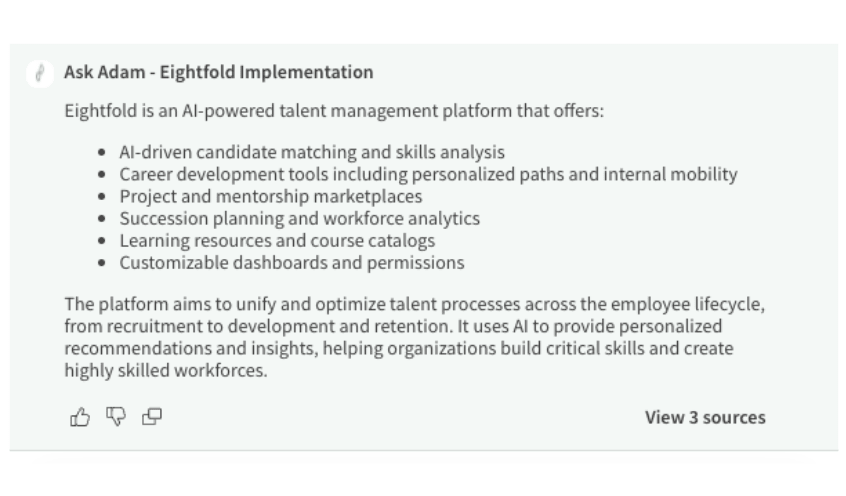
Ask Adam, our Eightfold implementation partner.
We’ve also taken a similar step in ensuring that all our implementation calls for our new Talent Management and Talent Acquisition tool, Eightfold.ai, were recorded and transcribed
This tool in particular is available in whole to our HR function as we learn and adopt the new system, but also all the enablement materials and calls are provided to all the employees too via an embedded agent in our Intranet site, enabling a natural language Q&A with the documentation designed to get them productive.
So what’s next?
We continue to test and develop tools to drive efficiencies from HR into Qlik too, these include:
Global and Local benefits
Event FAQs – think Compensation review, Talent Review, Open Enrolment
Policy reference
System use guides
We are also in the testing stages of the next version of Qlik Answers, enabling both unstructured and structured data to be examined and surfaced in answering questions. I’ve been looking ta this to for the last week or so, and very excited to see how this is working and the opportunity it will give our HR team the ability to act faster ‘on the fly’ and with confidence of the background data, by making insights conversational.
As with all AI, Qlik Answers isn’t about replacing the human side of HR - it’s about amplifying it with smarter, faster, and more accessible insights.