







In a Consolidating Market, Data Integration Is Your Control Point

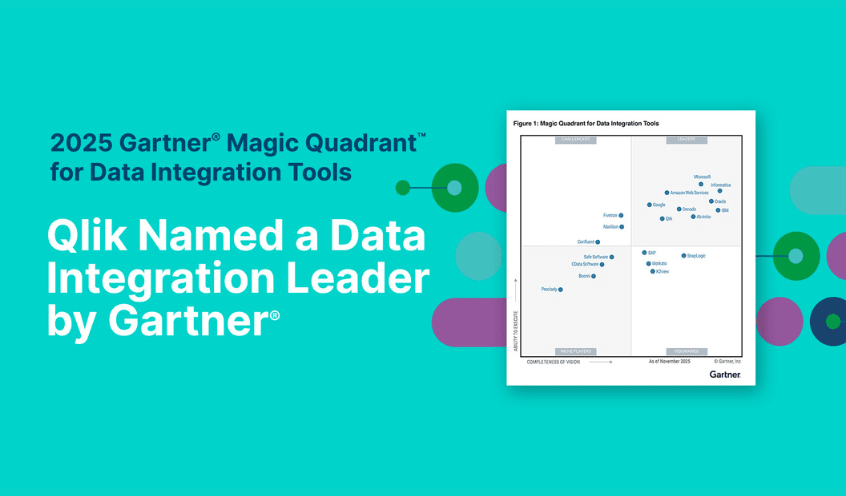
Gartner has once again named Qlik a Leader in the Magic Quadrant for Data Integration Tools, a position we have held for a decade. In that time, the landscape around data integration has shifted. Hyperscalers are moving up, large vendors are tightening their stacks, and acquisitions are reshaping customer choice.
For CIOs and CDOs, that consolidation changes the question. It is less about who sits where in the quadrant, and more about how much control you still have over your own data and AI strategy. Deloitte’s Global CIO Survey points in the same direction, avoiding vendor lock in and keeping architectural flexibility are now front and centre as more workloads move to cloud and AI.
In that world, data integration is not just plumbing. It is the control point that determines how much room you have to move when architecture, regulation, or cost changes.
Real time, hybrid, and open
High performance CDC and replication
Our log based change data capture and replication are described as among the strongest in the market. That translates into reliable real time feeds across databases, mainframes, and cloud targets for zero downtime migrations, hybrid cloud moves, and real time risk and operations.
Bulk movement and transformations
Gartner also notes the depth of our bulk and batch movement and transformations. The requirement here is predictable scale and as few surprises in production as possible, so teams can spend more time on new AI and analytics work, and less on keeping the lights on.
Broad connector coverage across hybrid and multicloud
Our wide connector coverage and support for on premises, cloud, and lakehouse environments sound like details, but they are a lever of freedom. They let you keep some workloads on premises, run others in AWS, Azure, or Google Cloud, and start adopting open formats such as Apache Iceberg, without reinventing your integration strategy each time you add something new.
Governance, metadata, and readiness for AI
Gartner rates our metadata management and governance capabilities above the market average. That includes lineage across pipelines, policy enforcement, and a clear view of how data flows. As AI touches more critical workflows, and regulators ask harder questions about where data came from and how it was used, this becomes central rather than optional.
Our patented Qlik Trust Score for AI, and in AI assisted pipeline design and quality checks, build on that foundation. You can only automate and score what you can see and govern.
Lakehouse and AI, without giving up flexibility
You can land data once in managed Iceberg tables, serve it to warehouses, AI workloads, and analytics engines, and avoid multiple proprietary copies that are expensive to run and hard to move. Trusted data products, an open lakehouse layer, and AI assisted integration give you an architecture where AI is a natural extension of your data work, not a separate science project.
Independence in a consolidating market
One line in the MQ that is easy to overlook is that Qlik continues to operate as an independent, hybrid focused, open platform.
When your DI platform is owned by your CRM vendor, or by your primary cloud, it will tilt toward their priorities. Roadmap, pricing, and integration depth will reflect that. When your DI platform is independent, you have more leverage and more choice. You can mix and match clouds and warehouses, negotiate based on value, and move when performance, cost, or regulation gives you a reason to.
That is what I mean by freedom. You should be able to design the data fabric and AI stack your business needs, and change it when circumstances change, without tearing everything down.
What you should take away
If you strip away the quadrant graphic, my read of this year’s report is simple. Real time, hybrid, and open architectures are now the default expectation. Governance, metadata, and AI readiness are becoming core decision criteria. Independence and flexibility still matter in a consolidating market.
For Qlik, the MQ validates the path we are on, from CDC and bulk movement, to connectors, governance, lakehouse, and AI augmented integration.
For leaders, the useful questions are straightforward. Can I move when I need to, across clouds, warehouses, or core systems, without starting from scratch. Can I prove my data is fit for AI and regulation, with clear lineage, policy enforcement, and trust signals. Am I running one coherent fabric, or a patchwork of tools, and what does that mean for cost, risk, and speed.
If those are the questions on your mind, we would be happy to walk through how Qlik Talend Cloud, Qlik Open Lakehouse, and our AI augmented integration approach line up against them.
We are rightly proud of our decade in leadership in data integration tools. The real test is how much freedom and control you feel when you use the platform.
Gartner, Magic Quadrant for Data Integration Tools, Michele Launi, Nina Showell, Robert Thanaraj, Sharat Menon, 8 December 2025
GARTNER is a registered trademark and service mark of Gartner, Inc. and/or its affiliates in the U.S. and internationally, and MAGIC QUADRANT is a registered trademark of Gartner, Inc. and/or its affiliates and are used herein with permission. All rights reserved.
Gartner does not endorse any vendor, product or service depicted in its research publications, and does not advise technology users to select only those vendors with the highest ratings or other designation. Gartner research publications consist of the opinions of Gartner’s research organization and should not be construed as statements of fact. Gartner disclaims all warranties, expressed or implied, with respect to this research, including any warranties of merchantability or fitness for a particular purpose.