







Forecast Smarter with Multivariate Time Series in Qlik Predict™


New deep learning models bring more accurate, explainable forecasting to Qlik Cloud®.
Accurate forecasting is one of the hardest problems for analytics teams. Demand shifts, supply chain constraints, and external factors like weather or pricing often interact in ways that simple models cannot capture.
With the release of multivariate time series forecasting in Qlik Predict™, business analysts can now model how multiple variables evolve together over time, directly inside Qlik Cloud, without writing code.
Why Multivariate Forecasting Matters
Traditional time series looks at one variable in isolation, like sales volume. But real-world business outcomes are shaped by multiple drivers working together.
Retail demand may be influenced by promotions, competitor pricing, and holidays.
Manufacturing output may depend on supply availability, labor hours, and seasonal trends.
Finance teams may forecast revenue by factoring in exchange rates, customer growth, and product mix.
By analyzing multiple inputs at once, multivariate time series produces forecasts that reflect real complexity and deliver results that business leaders can act on.

Three New Deep Learning Models
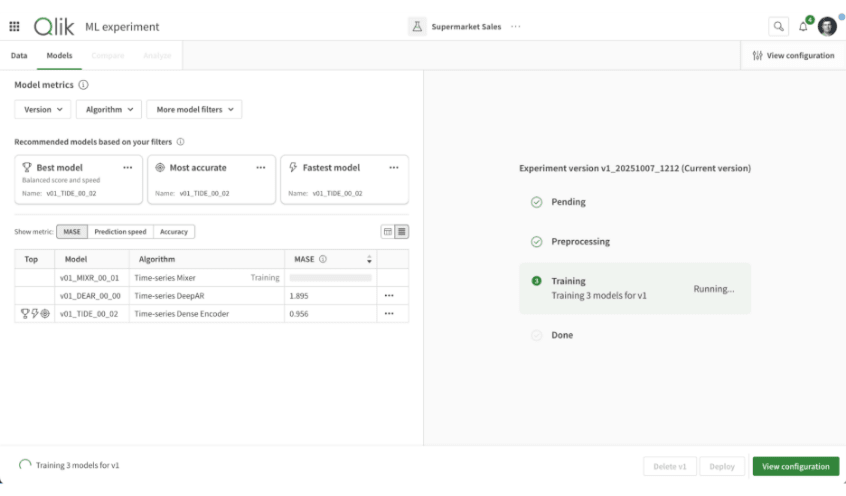
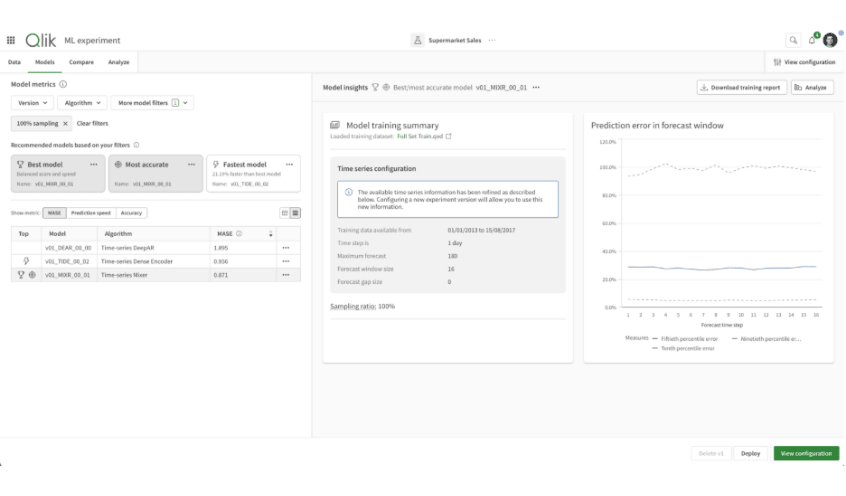
To support multivariate time series forecasting, Qlik Predict is introducing three state-of-the-art algorithms optimized for different forecasting patterns and use cases. Each is GPU-accelerated for scale and performance.
DeepAR – Probabilistic forecasting well-suited for retail and supply chain use cases.
TiDE (Time-series Dense Encoder) – Captures long-term dependencies in large datasets.
TSMixer – Efficient, transformer-inspired model that balances accuracy and speed.
Designed for Analysts, Not Just Data Scientists
Forecasting with multiple drivers is powerful but traditionally requires heavy feature engineering that typically only a data scientist can do. Qlik Predict simplifies the process with:
Automated data preparation and feature handling to make complex datasets ready for modeling.
An intuitive, no-code interface that guides users through building and comparing forecasts.
Transparent model setup and performance metrics so teams can understand results and validate accuracy.
This means analysts can move from dataset to forecast in minutes, while data scientists gain governed, enterprise-ready outputs they can trust.


Business Value in Action
Multivariate time series unlocks new use cases across industries, helping teams not only predict outcomes, but also explain what drives them and act on those insights.
Sales and Marketing – Predict campaign performance across regions and seasons, explain which channels or price points drive results, and act by reallocating spend in real time.
Operations – Forecast production or supply levels under changing demand, explain where bottlenecks or delays arise, and act by adjusting schedules or procurement plans.
Finance – Model revenue and expenses with external drivers like inflation or FX rates, explain which cost centers or markets impact margins, and act through smarter budget allocation.
Healthcare – Forecast patient volumes and supply consumption, explain which factors influence peaks in demand, and act by optimizing staff scheduling and resource readiness.
Public Sector – Predict community service demand or funding needs, explain the influence of population growth or seasonal shifts, and act by aligning budgets and staffing proactively.
Human Resources – Forecast workforce changes and turnover, explain which factors correlate with attrition or productivity, and act by adjusting hiring or retention strategies.
Across these industries, customers are using Qlik Predict to create sharper forecasts, uncover the “why” behind trends, and turn those insights into confident, data-driven decisions.
What’s Next
Multivariate time series is now fully available in Qlik Predict, giving Qlik Cloud users access to enterprise-grade forecasting across multiple business drivers.
With this release, customers can move from single-variable forecasts to true multivariate modeling, using modern deep learning algorithms that capture the relationships between demand, pricing, seasonality, and more.
Next, our teams are focused on expanding the value of predictive AI in three key areas:
Explainability and transparency – New visual insights will make it easier to interpret model drivers and confidence levels directly within Qlik Cloud.
Scalability for larger datasets – Upcoming enhancements will support higher data volumes and longer time horizons, unlocking even more enterprise scenarios.
Monitoring and model drift detection – Built-in tracking tools will help ensure model accuracy and governance over time.
These innovations build on Qlik’s commitment to practical, governed AI that connects prediction, explanation, and action in one seamless experience.
Get Started
You can begin exploring multivariate forecasting in your own Qlik Predict environment today. Create new experiments with multiple drivers, compare model results, and visualize how changes in key factors could shape future outcomes.
For practical guidance, visit the Qlik Help site and Qlik Community to access tutorials, sample data, and best practices from other users.
Explore multivariate time series in Qlik Predict today and see how predictive AI, analytics, and automation come together to turn foresight into action.