







Our customers’ worlds are complex, and for good reason. It’s multi-cloud. It’s SaaS plus on-prem. It’s Snowflake, Databricks, AWS, Azure, Salesforce, and more.
Underneath every one of those choices is the same constraint: data must be accessible, stay current, and stay controlled. The hard part is getting trusted data where it needs to be, when it needs to be there, with the controls to use it responsibly. That is what determines whether AI becomes operational and valuable or stays stuck in pilots.
That is the real starting point for agentic AI.
This is why agentic AI raises the stakes. Agents turn data into actions. They trigger workflows, influence decisions, and move at machine speed. If the data foundation is brittle, closed, or low quality, progress slows, costs rise, and risk compounds.
Customers do not want to rebuild their stack for it. They want to use what they already have, connect it, trust it, and keep moving. That is exactly what we mean by making data work for AI.
Built for the ecosystems customers already run
Most organizations are not choosing one platform and calling it done. They are building ecosystems, and they need partners who add value inside those ecosystems, without forcing a rip-and-replace.
Qlik is built for that reality. We serve customers across Qlik, Talend, Stitch, and Attunity, which means we are extending what teams already rely on, not asking them to begin again. The scale is real. Every month, customers move petabytes of data, run 120M Talend executions, and trigger 60M Analytics Engine reloads.
Usage is not just sticky, it give credibility. This matters as customers shift from pilots to production. In December 2025, about two-thirds of licensed Qlik Cloud Analytics users were active, and roughly one in four monthly users came back every day, showing strong day-to-day adoption. Qlik Predict and Qlik Answers show the same repeat-use pattern, with 68% and 55% returning users. That signals habit, not experimentation and that Qlik is part of the operating rhythm.
At the same time, we are building for where the market is going. Agentic experiences. Open Lakehouse patterns. Trust measurement for AI. Faster paths from data to action.
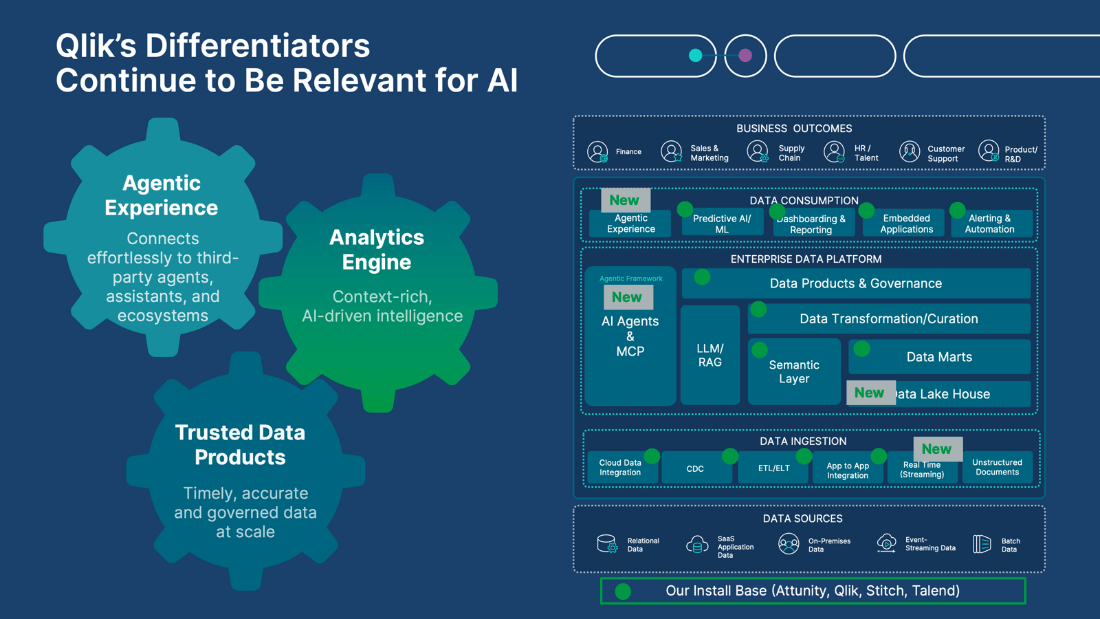
And we have three unique capabilities that work together:
Trusted data products
A context-rich analytics engine
An agentic experience that becomes a force multiplier
Here’s what that means in practice.
1) Trusted data products, not raw feeds
Customers do not want more pipelines. They want data products they can reuse, trust, and explain. With agents, trust stops being a nice-to-have. It becomes a control point. If the data is unreliable, every downstream action becomes a risk decision.
That is why we focus on trusted data products from ingestion to delivery, at scale. In practice, that means:
Streaming and change capture, so workflows run on current inputs, not stale snapshots.
Curated, governed datasets built for reuse, not one-off pipelines that break when something changes.
Trust you can measure, with quality scoring plus lineage, metadata, and policy controls built in.
Trust also has an economics side. If reliable data is too slow or too expensive to produce, it will not scale. Customers need ingestion and compute that stay efficient as usage grows.
2) The Analytics Engine, the difference between answers and understanding
I hear this a lot, “We don’t just need answers. We need to understand what’s driving them.”
If trust is reliability, context is meaning. Context keeps AI from producing plausible answers that are directionally wrong. It also helps people, and agents, make better decisions over time.
This is where Qlik’s Analytics Engine stands out. For 30 years, Qlik has built context-aware analysis that helps teams explore data, see relationships others miss, and keep refining questions without waiting for the system to catch up. In the agentic era, that context has to persist across a chain of decisions, with transparency into how conclusions were reached, and performance that holds up at scale.
3) An Agentic AI experience that works with Data Products and the Analytics Engine
Customers want an experience layer that makes work easier, faster, and more usable. They do not want another tool sitting off to the side. They want an agentic experience that works with trusted data products and the Analytics Engine and turns both into force multipliers.
That means natural-language interaction with governed data, actions taken in the flow of work with the right permissions, and automation that strengthens governance rather than bypassing it. Humans stay in the loop where risk and accountability demand it.
What this unlocks
When data is trusted, current, and governed, everything changes. Teams stop treating AI like a special project and start using it as an operating capability. Decisions move faster. Automation becomes safer. And value scales without the business trading speed for risk. That is the outcome customers are pushing toward, and it’s what we mean by Qlik, Making Data Work for AI.
Mike Capone published a companion blog that makes the case from the customer and leadership perspective, why trusted, contextual data is the difference between AI experimentation and AI at scale. Read more here.
In this article:
AI