










Building Your Next-Gen Lakehouse with Qlik, AWS, and Apache Iceberg

Introduction
Real-time analytics has become a cornerstone of modern enterprises. Businesses are no longer satisfied with waiting hours or days for insights—they demand answers in seconds. The rise of AI, machine learning, and generative AI has only accelerated this need, putting immense pressure on data platforms to deliver reliable, scalable, and flexible architectures. Moreover, customers are increasingly demanding open, interoperable architectures that seamlessly integrate with their ecosystem, helping unlock the full value of their data, while driving down infrastructure spending. This is where the open Lakehouse model, powered by Qlik, AWS, and Apache Iceberg, steps in to provide a unified foundation for innovation.
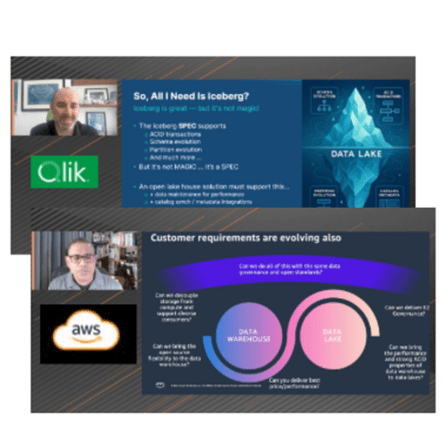
Watch the On-Demand webinar - Building Your Next-Gen Lakehouse with Qlik, AWS, and Apache Iceberg
Why a Strong Data Foundation Matters
AI and generative AI applications are only as strong as the data they rely on. A reliable, well-structured, and accessible data foundation is critical. Enterprises must integrate data from diverse sources—batch, streaming, structured, semi-structured, and unstructured—and ensure that data pipelines can keep up with rapid changes. Equally important are governance, quality, and security controls that ensure trustworthy data. With these in place, organizations can unlock real-time analytics that fuel smarter decisions and customer experiences.
The Evolution of Data Architectures
Data platforms have evolved rapidly over the past two decades. Early data warehouses were focused on structured data from transactional systems for reporting. Data lakes emerged to handle large volumes of data more cheaply but often lacked governance and accessibility. Today, the Lakehouse concept blends the best of both worlds: the governance and reliability of warehouses with the scalability and flexibility of lakes. This unified approach supports real-time analytics, schema-on-read processing, and advanced AI/ML workloads at scale.
Learn more about the Lakehouse architecture and why it matters.
Open Table Formats and Why Apache Iceberg Stands Out
Open table formats such as Apache Iceberg, Apache Hudi, and Delta Lake are key enablers of the modern Lakehouse. They introduce features like ACID transactions, schema evolution, time travel, and concurrency control—all within low-cost object storage like Amazon S3. Among these, Apache Iceberg has emerged as the preferred standard. Fully embraced by AWS, Iceberg combines the reliability of a warehouse with the openness and scale of a lake, making it a powerful foundation for analytics and AI.
Learn more about the basics of Apache Iceberg
The Challenges of Traditional Data Platforms
Most organizations don’t have just one data platform. Over time, they accumulate multiple platforms for warehousing, computing, and analytics. This leads to inefficiencies, including high costs of ingesting and transforming data, complexity in managing pipelines, and risks of vendor lock-in. As low-latency use cases grow, these challenges only intensify, pushing organizations to seek more open, unified solutions.
Iceberg-Specific Challenges in Real-Time Use Cases
While Iceberg offers many advantages, it is not without challenges—particularly in real-time ingestion scenarios. Frequent writes create thousands or even millions of small files, slowing down queries. Snapshots, which preserve transactional consistency, can balloon over time, adding metadata overhead. Unneeded or orphaned files can also bloat storage. Without careful optimization, these issues can undermine performance and efficiency.
The Qlik Open Lakehouse on AWS
Qlik Open Lakehouse, a key capability within Qlik Talend Cloud and strengthened by the Upsolver acquisition, directly addresses these challenges.
It introduces four core capabilities:
High-throughput, low-latency ingestion from 200+ diverse sources including Oracle, PostgreSQL, diverse SaaS sources, SAP, mainframes and more.
Adaptive Iceberg Optimization, which automates file compaction, dynamic partitioning, and intelligent file cleanup to maintain performance, while lowering storage footprint.
Data Warehouse Mirroring, which makes Iceberg tables directly query-able in systems like Snowflake without duplicating data.
Interoperable by design, ensuring compatibility with diverse query and processing engines including Snowflake, Amazon Athena, Amazon Sagemaker Studio, Trino, Presto, and more.
Together, these features ensure that Iceberg can serve as the true center of a data architecture.
Real-World Integration with AWS
The Qlik Open Lakehouse cluster operates directly within the customer’s AWS environment, seamlessly using Amazon S3 for storage and a fully managed compute layer. It eliminates the need for a data warehouse for ingesting data into Iceberg and leverages cost-efficient Amazon EC2 Spot Instances—complete with auto healing —to deliver up to 50–90% lower ingestion costs and overall reduced compute usage. The result? A high-performance, cost-effective foundation for building truly open Lakehouse's.
The Qlik Open Lakehouse also integrates seamlessly with AWS services such as AWS Glue, Amazon Athena, and Amazon SageMaker Studio, while also supporting downstream analytics platforms such as Snowflake. Customers can also use Qlik Cloud Analytics with Amazon Athena to effortlessly query data in the Lakehouse. This flexibility allows organizations to ingest once and serve many—using the same Iceberg tables to power both operational analytics and business intelligence dashboards. It’s a data-centric approach that eliminates silos and ensures consistency across diverse use cases.
Learn more about Qlik Open Lakehouse
Benefits of the Open Lakehouse Approach
By adopting an open Lakehouse powered by Qlik, AWS, and Apache Iceberg, organizations gain several advantages:
A unified and open data foundation that supports analytics, AI, and generative AI.
Improved performance through automated and continuous table optimizations.
Cost efficiencies through scaling strategies and use of Amazon EC2 spot instances.
Flexibility to meet multiple business needs without duplicating data, while being able to query with a range of engines
Ultimately, this model enables enterprises to be more agile, open, data-driven, and more innovative.
Conclusion
The data landscape is shifting rapidly, and enterprises need architectures that can keep pace. The open Lakehouse model, underpinned by Apache Iceberg, provides scalability, governance, and performance required for modern AI-driven workloads. Qlik’s Open Lakehouse ensures that organizations can overcome Iceberg’s ingestion and optimization challenges, scale real-time analytics efficiently, and deliver trusted data across platforms. For companies aiming to become truly data-centric, the open Lakehouse is no longer optional—it’s essential.
Learn More:
[Blog] Qlik Open Lakehouse: Now Generally Available
[Webinar] Build Your Next-Gen Lakehouse with Qlik, AWS, and Apache Iceberg
[Webpage] Qlik Open Lakehouse