DATA MOVEMENT
Automate an Enterprise-Grade Replication Process
Accelerate data delivery to data lakes, data warehouses, and cloud architectures.

How a data movement platform operates
Minimize operational impact.

Get the data you need
Hundreds of applications and data sources — in the cloud or on premises.

Eliminate manual tasks
Configure once and then just control and monitor.

Automatically move and update
data from any source with Qlik

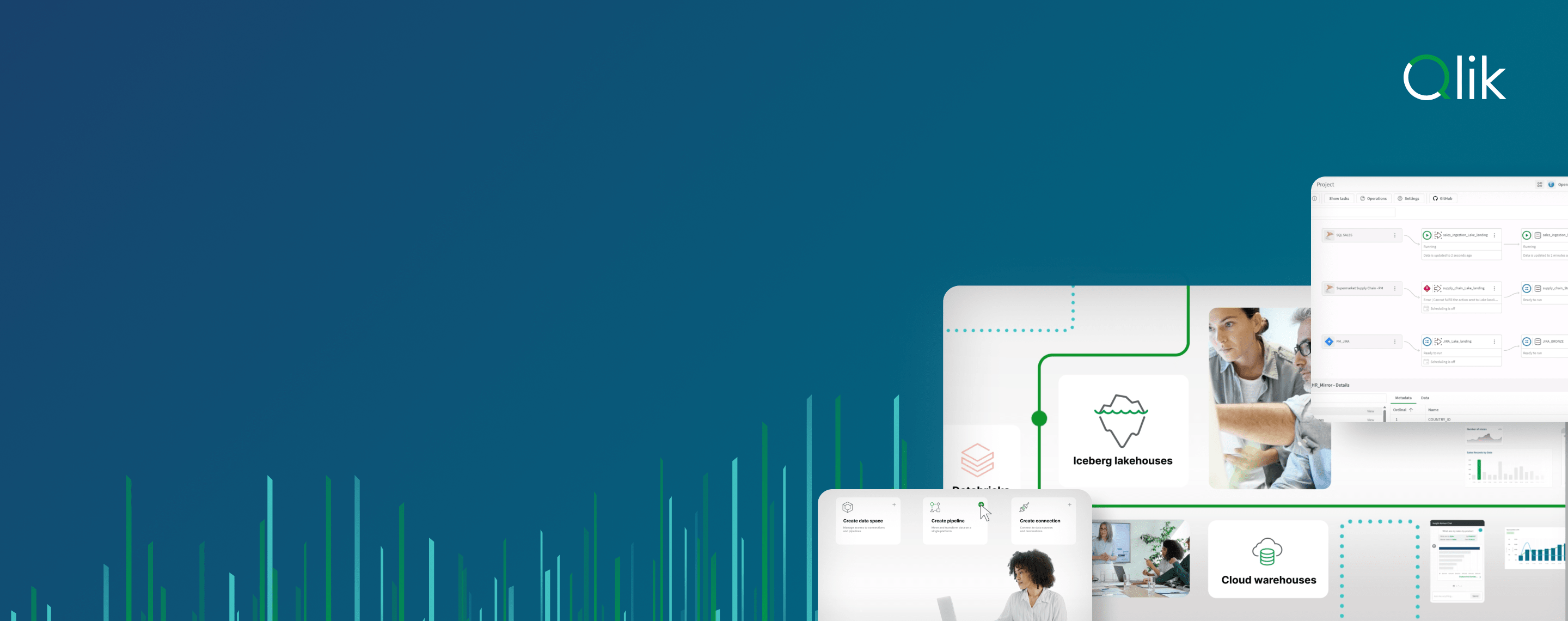
Integrate data across cloud, hybrid, and on-premises environments

SAP

Adobe

IBM

AWS

MySQL

Jira

Azure

MS SQL

Apache

Mongo DB
SAP
Adobe
IBM
AWS
MySQL
Jira
Azure
MS SQL
Apache
Mongo DB
SAP
Adobe
IBM
AWS
MySQL
Jira
Azure
MS SQL
Apache
Mongo DB
SAP
Adobe
IBM
AWS
MySQL
Jira
Azure
MS SQL
Apache
Mongo DB
SAP
Adobe
IBM
AWS
MySQL
Jira
Azure
MS SQL
Apache
Mongo DB

Oracle

Salesforce

Workday

Apache Iceberg

CircleCI

Zendesk

Snowflake

Databricks


OpenAI

Intuit
Oracle
Salesforce
Workday
Apache Iceberg
CircleCI
Zendesk
Snowflake
Databricks
OpenAI
Intuit
Oracle
Salesforce
Workday
Apache Iceberg
CircleCI
Zendesk
Snowflake
Databricks
OpenAI
Intuit
Oracle
Salesforce
Workday
Apache Iceberg
CircleCI
Zendesk
Snowflake
Databricks
OpenAI
Intuit
Oracle
Salesforce
Workday
Apache Iceberg
CircleCI
Zendesk
Snowflake
Databricks
OpenAI
Intuit
Get the data you need
Move data from an ever-growing variety of sources including mainframe, relational and non-relational databases, SaaS applications, enterprise applications such as SAP, multiple file formats, data lakes, and more; from multi-locations and in various formats.

Eliminate manual tasks
Execute initial data loads, then transition automatically to continuous updates. Automatically generate target databases based on metadata definitions in the source schema. Any schema modifications, such as table/column additions or changes to data types, can be replicated dynamically to the target.

Secure and compliant data pipelines
Qlik offers enterprise-grade security and compliance along with advanced connectivity options such as Private Links and SSH tunneling to secure the data pipeline.

Frequently Asked Questions (FAQs)
Data movement is the process of transferring data between systems, locations, or environments: from source databases and applications to targets like data lakes, data warehouses, and cloud platforms. It spans several methods, including replication, ingestion, and streaming, and it's the foundation for keeping analytics and AI systems supplied with current data. A data movement platform automates this end to end, moving data from many sources to a wide range of targets.
Data replication is the process of copying data from a source system to one or more targets and keeping those copies continuously in sync as the source changes. Unlike a one-time migration, replication is ongoing (updates in the source are propagated to the destination on a schedule or in near real time), which keeps warehouses, lakes, and operational systems aligned. At enterprise scale it's often done with log-based change data capture to move only what changed.
The most common approaches are full (snapshot) replication, which copies an entire dataset each run; incremental or key-based replication, which moves only records changed since the last sync; and log-based CDC, which reads a database's transaction log to capture every insert, update, and delete in real time. Replication is also categorized as full vs. partial by scope, and synchronous vs. asynchronous by timing. Most enterprise setups combine an initial full load with ongoing CDC to balance completeness and efficiency.
Data migration is a one-time move of data from one system to another, typically during a platform change or cloud move, after which the old source is retired. Data replication is continuous or scheduled: it keeps a live copy in sync with an ongoing source, so both systems stay current over time. Replication is also used to enable zero-downtime migrations, keeping the target updated until the cutover is complete.
A full load (initial load) copies the entire dataset from source to target in one pass, establishing the baseline. Change data capture (CDC) then takes over, continuously capturing only the inserts, updates, and deletes that happen afterward (usually by reading the database transaction log), so the target stays current without repeatedly reloading everything. The standard pattern is to run the initial load once, then transition automatically to ongoing CDC.
Schema drift is when the structure of source data changes unexpectedly (a new column, a renamed field, or a changed data type) without downstream systems being updated, which can silently break pipelines or corrupt data. It's handled through schema evolution: detecting the change and propagating it to the target automatically rather than relying on manual migration scripts. Modern tools address this by generating target tables from source metadata and replicating schema modifications dynamically, so changes flow through without breaking the pipeline.
Data ingestion is the process of collecting and importing data from various sources into a storage or processing system, such as a data lake, warehouse, or lakehouse, where it can be analyzed. It can happen in batch (scheduled bulk loads) or in real time (streaming individual changes as they occur), and it's the first step in most data pipelines. Replication with CDC is a common ingestion method because it continuously delivers fresh source data with minimal load on the origin system.
Mainframe data is moved to the cloud using replication tools that read changes directly from mainframe sources and deliver them to cloud targets, avoiding costly bulk extracts and minimizing impact on the source. Log-based change data capture is the preferred method because it continuously streams updates in near real time, which is essential for high-volume, high-velocity mainframe workloads. This lets organizations build cloud analytics on mainframe data without disrupting production systems.
SAP data is replicated using connectors that understand SAP's application and data structures, extracting from underlying tables and business objects and delivering them to cloud warehouses, lakes, or analytics platforms. The challenge is SAP's size and complexity, so purpose-built tooling selects the right data and keeps it current with change data capture rather than repeated full extracts. This lets SAP data be moved and managed efficiently across production and non-production environments.
No-code data replication lets teams set up and run data pipelines through a visual interface instead of hand-writing scripts or code, so data engineers and analysts can configure a source, target, and rules and let the platform handle the rest. The typical model is "configure once, then control and monitor": the tool automates initial loads, ongoing updates, and schema changes without manual intervention. This cuts engineering effort and speeds up delivery while keeping pipelines governed and secure.
Data synchronization software keeps data consistent across two or more systems, ensuring that a change made in one location is reflected in the others. It can operate one-way (from a source to a target) or two-way (keeping both systems mutually updated), and can run continuously in real time or on a set schedule. It's widely used to keep databases, applications, cloud services, and devices aligned, so everyone works from the same current data rather than conflicting copies.


