DATA INTEGRATION HUB
Deliver Trusted, Unified Data with Qlik's Data Integration Hub
Centralize, manage, and deliver trusted data across your enterprise with a comprehensive integration hub. Streamline data sharing, governance, and analytics delivery from a single platform.

Power every decision with centralized data management and distribution
Establish a single data integration platform that consolidates data from disparate sources, applies consistent governance, and distributes trusted information to analytics, AI, and business applications.

Accelerate insight delivery across teams and applications
Eliminate data silos and redundant integration efforts by centralizing data distribution through a hub that serves multiple consumers with governed, analytics-ready information.

Automate data delivery and synchronization at scale
Configure automated pipelines that continuously deliver updated data to downstream consumers, maintaining synchronization without manual intervention or custom integration development.

Support strategic decisions with governed data access
Provide self-service access to certified data through a centralized catalog while enforcing governance policies that protect sensitive information and maintain compliance.
How does Qlik's data integration hub work?
Step 1 - Connect and consolidate data from any source
Step 2 - Standardize, enrich, and catalog data centrally
Step 3 - Automate distribution to analytics and applications
Step 4 - Monitor, govern, and optimize data delivery

Why choose Qlik's data integration hub?
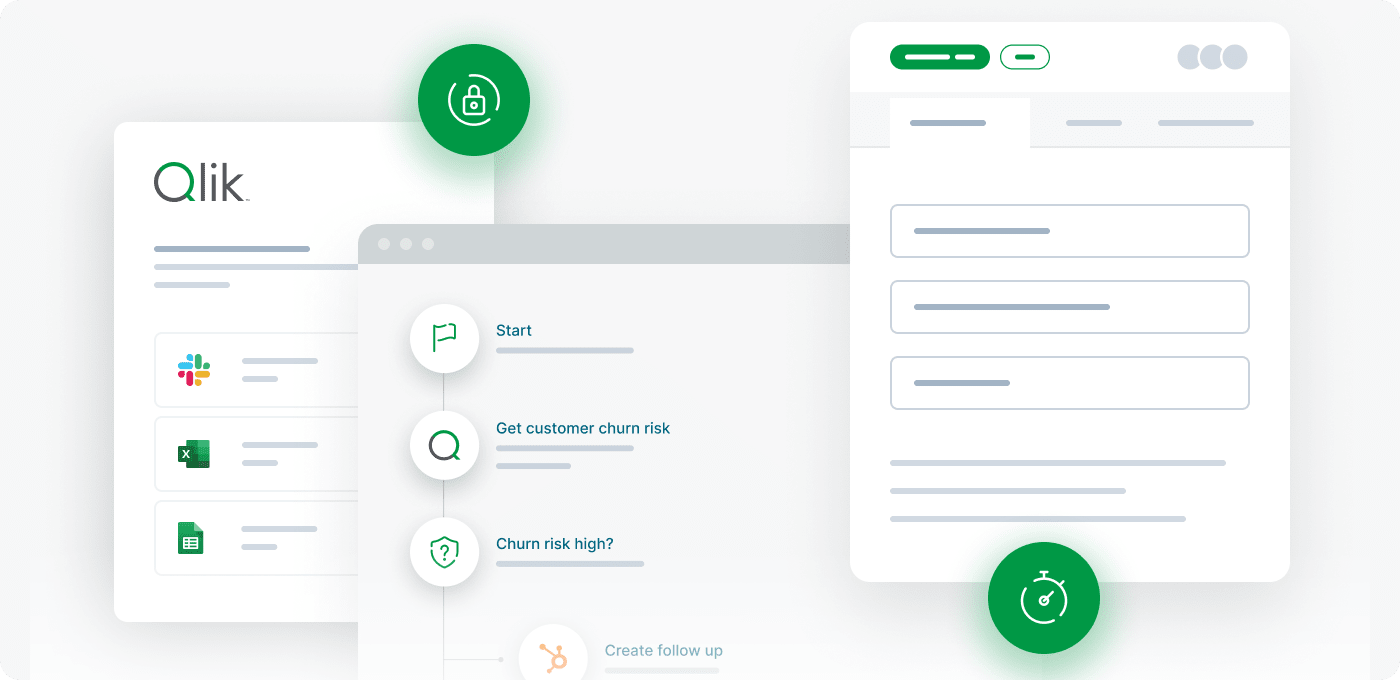
Complete visibility from source to consumption
Track data flow through the hub with comprehensive lineage that shows every transformation, distribution, and consumption point, enabling impact analysis and compliance reporting.

Global distribution with consistent governance
Deploy integration hubs across geographic regions and cloud platforms with centralized management that maintains consistent policies while optimizing for local data sovereignty.

Self-service discovery with automated governance
Enable data consumers to discover and request access to hub-managed data through catalogs and workflows, with automated policy enforcement that protects sensitive information.

Collaboration tools for all data stakeholders
Provide role-appropriate interfaces that enable engineers to build pipelines, architects to design topology, and business users to discover and consume data without technical expertise.

Trusted for enterprise-scale data distribution
Join organizations that eliminated data silos and accelerated analytics by centralizing data integration through Qlik's hub, serving thousands of users with governed information.
Key capabilities of Qlik's data integration hub

Centralized metadata and data catalog management
Organize enterprise data assets through unified catalogs that provide searchable inventories with business definitions, quality metrics, and usage information for discovery.

Automated data distribution and synchronization
Configure pub-sub patterns that automatically deliver data updates to multiple subscribers, maintaining synchronization across analytics, applications, and operational systems.

Integration with cloud warehouses, lakes, and BI tools
Connect the hub with Snowflake, Databricks, cloud storage, and business intelligence platforms through native integrations that simplify data delivery to consumption points.

Data pipeline orchestration
Coordinate complex data workflows across source ingestion, hub processing, and consumer delivery with dependency management and intelligent scheduling that ensures timely data availability.

Secure collaboration across business units
Enable data sharing between departments while maintaining security boundaries with federated access controls and encryption that protect sensitive information during distribution.

Enterprise-grade security and compliance
Protect centralized data with comprehensive security including encryption, access controls, data masking, and audit logging that supports regulatory compliance and security policies.
Trusted by leading enterprises worldwide


What our customers say


We needed to consolidate data in one place, from heterogeneous sources, updated in almost real-time. That’s what Qlik enables for us.


Connect to 500+ data sources with Qlik’s analytics integrations

SAP

Adobe

IBM

AWS

MySQL

Jira

Azure

MS SQL

Apache

Mongo DB
SAP
Adobe
IBM
AWS
MySQL
Jira
Azure
MS SQL
Apache
Mongo DB
SAP
Adobe
IBM
AWS
MySQL
Jira
Azure
MS SQL
Apache
Mongo DB
SAP
Adobe
IBM
AWS
MySQL
Jira
Azure
MS SQL
Apache
Mongo DB
SAP
Adobe
IBM
AWS
MySQL
Jira
Azure
MS SQL
Apache
Mongo DB

Oracle

Salesforce

Workday

Apache Iceberg

CircleCI

Zendesk

Snowflake

Databricks


OpenAI

Intuit
Oracle
Salesforce
Workday
Apache Iceberg
CircleCI
Zendesk
Snowflake
Databricks
OpenAI
Intuit
Oracle
Salesforce
Workday
Apache Iceberg
CircleCI
Zendesk
Snowflake
Databricks
OpenAI
Intuit
Oracle
Salesforce
Workday
Apache Iceberg
CircleCI
Zendesk
Snowflake
Databricks
OpenAI
Intuit
Oracle
Salesforce
Workday
Apache Iceberg
CircleCI
Zendesk
Snowflake
Databricks
OpenAI
Intuit
Resources


Data integration hub FAQs
Hubs centralize integration logic in one platform that serves multiple consumers, eliminating redundant pipelines and providing consistent governance versus point-to-point approaches that create integration sprawl.
Yes, the hub supports both continuous streaming delivery and scheduled batch distribution, allowing you to optimize delivery patterns based on consumer requirements and data characteristics.
Distributed architecture enables horizontal scaling of both ingestion and distribution capabilities, with intelligent caching and query optimization that maintains performance as consumer counts grow.
Continuous operation delivered through high availability configurations with automated failover. Data loss during disruptions is prevented by checkpoint recovery and queue persistence.