Power every decision with AI-ready data, automation, and enterprise-grade analytics
Transform disconnected data into actionable intelligence with AI-driven analytics, automation, and enterprise-grade governance.

Accelerate insight generation across teams and functions

Automate repetitive tasks and deliver business-ready insights at scale
Use AI and automation to streamline data preparation, enrichment, and analysis—freeing teams to focus on strategic work and high-value outcomes.

Support strategic decision-making with trusted, governed data
Ensure accuracy and consistency with end-to-end governance, giving leaders the confidence to act on insights they can trust.
How does Qlik's AI analytics platform work?
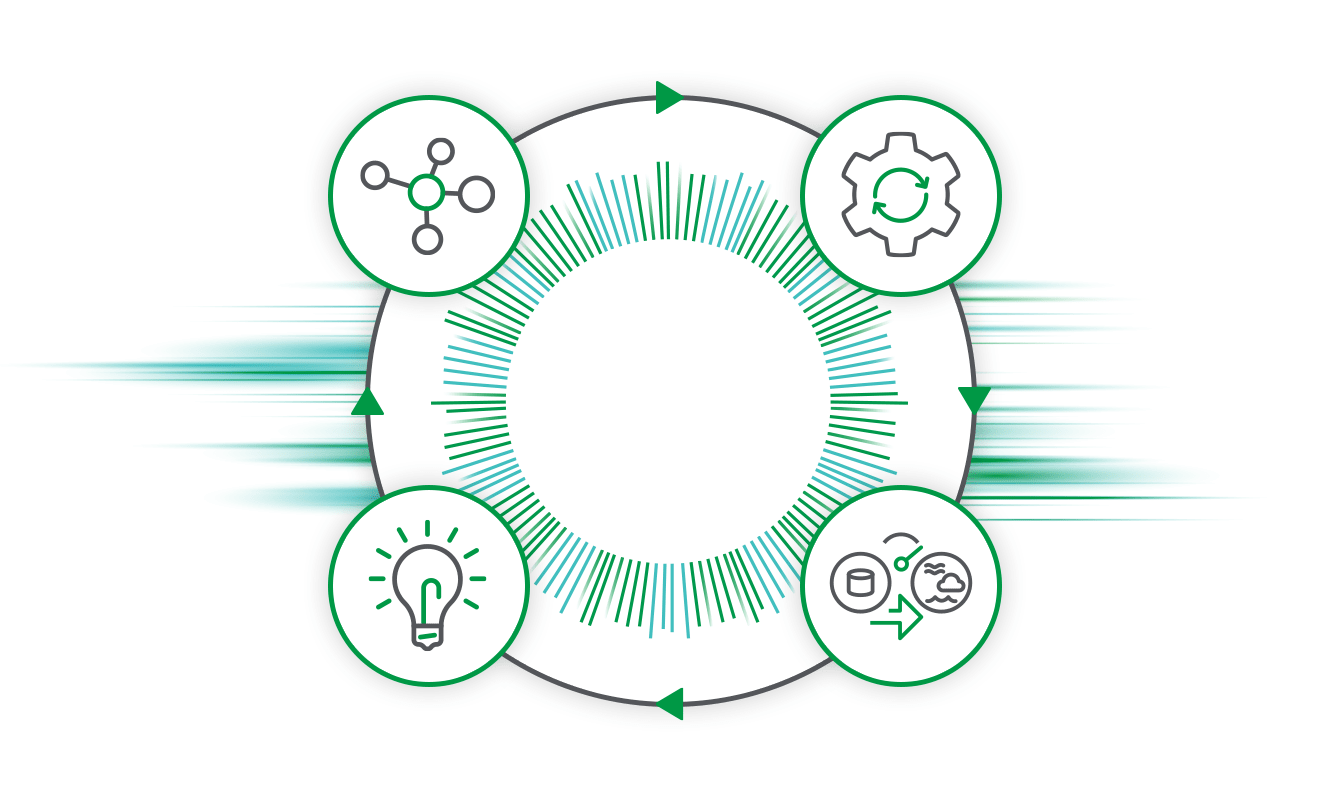
Step 1 – Connect and ingest data from any source
Step 2 – Use AI to clean, transform, and analyze in real time
Step 3 – Generate predictive, visual, and natural language insights
Why Qlik AI analytics?
Harness AI-powered analytics with enterprise-grade governance, scalability, and ease of use — designed to deliver trusted insights at every level.

Enterprise-grade governance with end-to-end data trust
Protect data integrity with built-in governance, quality controls, and compliance frameworks that keep every insight accurate and reliable.

Seamless scalability across departments, regions, and cloud environments
Deploy analytics anywhere — on-premises, in the cloud, or hybrid — while supporting teams of any size without compromising performance.

Easy-to-use platform with drag-and-drop simplicity and NLP capabilities
Empower everyone to explore data with intuitive visualizations, natural language queries, and AI-assisted insights — no coding required.

Built for business users and data teams alike
Bridge the gap between technical and non-technical users with collaborative tools that align strategy, operations, and innovation.

Proven results across global enterprises
Trusted by thousands of organizations worldwide to accelerate growth, improve efficiency, and unlock new opportunities with data.
Key capabilities of Qlik's AI analytics software
From AI-driven automation to enterprise-grade governance, Qlik delivers the tools your teams need to turn data into trusted, actionable insight.

AI-powered workflows for automation at scale
Streamline data preparation, enrichment, and analysis with AI-driven workflows that reduce manual effort and speed decision-making.

Intelligent forecasting and predictive modeling
Anticipate trends and outcomes with advanced analytics that uncover patterns, simulate scenarios, and guide proactive strategies.

Natural language queries and AI-generated SQL
Ask questions in everyday language and instantly generate SQL queries to explore, filter, and analyze data with ease.

Visual data discovery with augmented analytics

Self-service dashboards and collaboration tools

Enterprise-grade governance and security
Safeguard sensitive information with robust governance, access controls, and compliance support across your entire analytics environment.
Trusted by the world’s leading enterprises


We needed to consolidate data in one place, from heterogeneous sources, updated in almost real-time. That’s what Qlik enables for us.


Connect to 500+ data sources with Qlik’s analytics integrations

SAP

Adobe

IBM

AWS

MySQL

Jira

Azure

MS SQL

Apache

Mongo DB
SAP
Adobe
IBM
AWS
MySQL
Jira
Azure
MS SQL
Apache
Mongo DB
SAP
Adobe
IBM
AWS
MySQL
Jira
Azure
MS SQL
Apache
Mongo DB
SAP
Adobe
IBM
AWS
MySQL
Jira
Azure
MS SQL
Apache
Mongo DB
SAP
Adobe
IBM
AWS
MySQL
Jira
Azure
MS SQL
Apache
Mongo DB

Oracle

Salesforce

Workday

Apache Iceberg

CircleCI

Zendesk

Snowflake

Databricks


OpenAI

Intuit
Oracle
Salesforce
Workday
Apache Iceberg
CircleCI
Zendesk
Snowflake
Databricks
OpenAI
Intuit
Oracle
Salesforce
Workday
Apache Iceberg
CircleCI
Zendesk
Snowflake
Databricks
OpenAI
Intuit
Oracle
Salesforce
Workday
Apache Iceberg
CircleCI
Zendesk
Snowflake
Databricks
OpenAI
Intuit
Oracle
Salesforce
Workday
Apache Iceberg
CircleCI
Zendesk
Snowflake
Databricks
OpenAI
Intuit
Data Integration and Quality Resources


AI analytics FAQs
No. Customers may choose the cloud region to host their tenant based on the availability of Qlik’s AI products and capabilities. Once a cloud region has been selected, Qlik will only host the customer’s data in that region.
Yes, Qlik complies with all laws applicable to our business, including the EU AI Act.
Qlik’s AI would be classified under the EU AI Act as either (a) “general AI” with ‘Limited Risk’ for those AI features which can be used for general purposes (e.g., Qlik Answers), or (b) AI with ‘Minimal Risk’ for those AI features capable of performing narrow tasks (e.g., SQL Assistant and Dataset Description Assistant).
Qlik’s AI meets transparency and explainability requirements applicable to AI systems by flagging to customers and users (a) when they are interacting with AI, (b) where the output is generative AI generated, and (c) where relevant, explaining why/how the AI generated the response it did to assist with human review of the output.
Qlik’s measures to ensure compliance with the EU AI Act include:
Regular staff training on AI compliance and AI literacy
An AI Policy which includes:
prohibitions on use and development of AI for prohibited uses; and
mandatory AI governance reviews for AI development.
Please note that Qlik’s AI offerings are not designed for and should not be used for High-Risk purposes under the EU AI Act or similar legislation around the world.