NATURAL LANGUAGE QUERY ANALYTICS
Simplify Complex Data through Natural Language Query Analytics
Find data insights by asking questions in plain English. Qlik's natural language query analytics allows any user to explore data without writing code or queries. Use our software to move from manual reporting to instant data discovery across the organization.

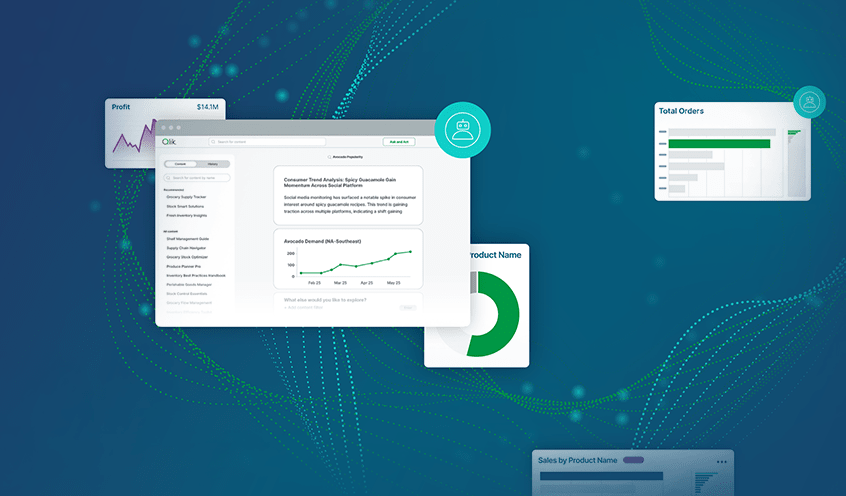
Ask questions in plain language and get instant data insights
Qlik provides natural language query tools that help business users find relevant insights using everyday language. This approach removes the technical barriers to data access.

Empower non-technical users with self-service analytics
Most data users lack the technical knowledge to write structured database queries. Our NLQ system allows users to interact with raw data naturally, making data exploration accessible to anyone in the organization.

Support faster choices with conversational interfaces

Scale data accessibility across enterprise environments
Deploy a natural language query NLQ solution that understands business terminology and specific business terms. Qlik identifies relevant data and provides trusted answers to keep your team informed.
How Qlik's natural language query analytics works
Step 1 - The system identifies user intent and business context from plain-language user questions
Step 2 - Machine learning models map the query to semantic models and consistent metric definitions
Step 3 - The analytics solution generates relevant answers and data stories automatically

Why choose Qlik for natural language query analytics?

Find hidden relationships that search-based NLQ tools miss
Linear tools only show what you ask for. Our associative engine connects all your data points to provide a full semantic context for every language query.

Build trust with centralized data governance and lineage
Make sure your AI-driven insights are trusted and secure. Qlik provides the data governance controls needed to protect sensitive information while providing broader data access.

Combine NLQ with advanced business intelligence capabilities
Move beyond predefined queries. Our AI Analytics Solution uses machine learning to identify patterns in customer behavior and performance metrics.
Automate complex queries and report generation with AI agents
Use Agentic AI to automate data discovery and trigger system actions. This technology turns raw business data into a strategic tool for decision-making.
Core capabilities of Qlik's natural language query analytics

NLQ for business users and non-technical staff
Allow anyone in your data teams to query data using human language. This reduces the burden on data analysts for routine analysis and manual reporting.

Semantic layers and business context awareness
Our software uses semantic layers to understand business definitions. This makes sure the NLQ system provides consistent answers based on your unique business logic.

Intelligent handling of ambiguous queries
Qlik uses natural language processing to clarify ambiguous queries. It suggests the best way to interpret user questions to provide the most relevant insights.

Automated visualization of data requested
When a user asks a question, the system identifies the best chart type to explain the data. This helps data users understand complex tasks through visual data stories.

Direct data access for SQL-free exploration
Move beyond writing queries or writing SQL. Users can explore data independently across multiple analytics systems using a simple natural language interface.

Smooth integration with existing data systems
Qlik provides smooth data integration for diverse data sources. We use Qlik Talend Data Integration to manage data preparation and data quality.
Natural language query analytics FAQs
Standard search finds keywords. NLQ analytics uses natural language understanding to interpret the meaning behind user queries and perform a structured query against a database to find accurate answers.
Yes, NLQ tools are designed for people without technical knowledge. Users can analyze data and get relevant insights using plain language instead of technical resources.
The system uses machine learning and a solid semantic context to break down complex queries. It can process large volumes of business data to identify trends and performance metrics instantly.
Connect to 500+ data sources with Qlik’s analytics integrations

SAP

Adobe

IBM

AWS

MySQL

Jira

Azure

MS SQL

Apache

Mongo DB
SAP
Adobe
IBM
AWS
MySQL
Jira
Azure
MS SQL
Apache
Mongo DB
SAP
Adobe
IBM
AWS
MySQL
Jira
Azure
MS SQL
Apache
Mongo DB
SAP
Adobe
IBM
AWS
MySQL
Jira
Azure
MS SQL
Apache
Mongo DB
SAP
Adobe
IBM
AWS
MySQL
Jira
Azure
MS SQL
Apache
Mongo DB

Oracle

Salesforce

Workday

Apache Iceberg

CircleCI

Zendesk

Snowflake

Databricks


OpenAI

Intuit
Oracle
Salesforce
Workday
Apache Iceberg
CircleCI
Zendesk
Snowflake
Databricks
OpenAI
Intuit
Oracle
Salesforce
Workday
Apache Iceberg
CircleCI
Zendesk
Snowflake
Databricks
OpenAI
Intuit
Oracle
Salesforce
Workday
Apache Iceberg
CircleCI
Zendesk
Snowflake
Databricks
OpenAI
Intuit
Oracle
Salesforce
Workday
Apache Iceberg
CircleCI
Zendesk
Snowflake
Databricks
OpenAI
Intuit