Count on real-time CDC streaming data
Extend enterprise data into live streams with this simple, universal solution.

Change data capture
A simple, real-time solution for continually ingesting and replicating enterprise data when and where it’s needed.

Broad support for source and targets
Get a single solution for data integration with the industry’s broadest platform coverage.

Enterprise-wide monitoring and control
Configure, execute, and monitor integration tasks across the enterprise from a single command center.
Qlik CDC streaming


High performing data pipelines
Stream high-speed real-time data from any source to any target.

Undisrupted source systems
Implement high-performing data pipelines without impacting production systems.

Simple graphical interfaces
Easily replicate data for your sources and targets.

Real-time updates as they occur
Utilize Change Data Capture to provide the freshest data throughout the enterprise for mission and customer critical analytics.
KEY RESOURCE
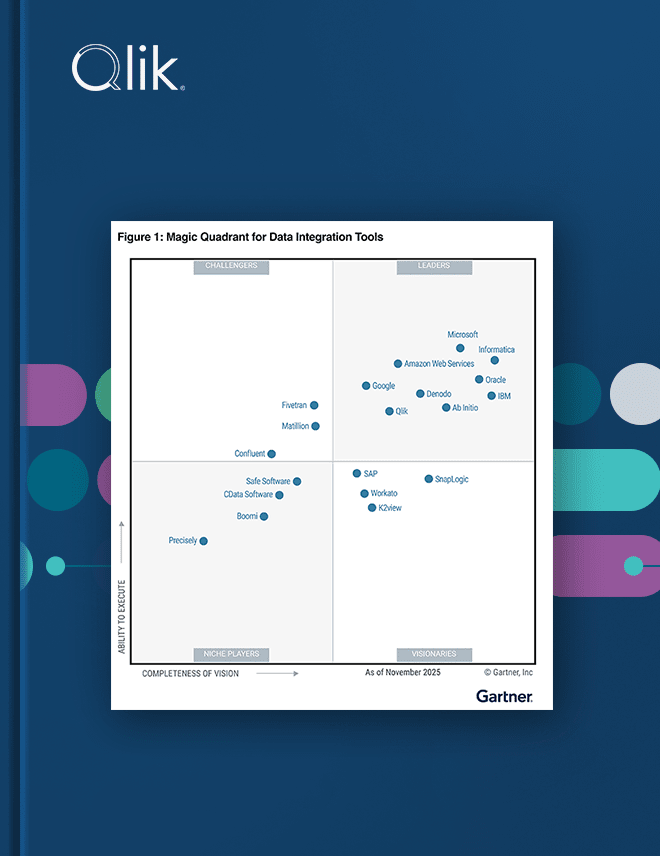
2025 Gartner® Magic Quadrant™ for Data Integration Tools
For the 10th consecutive year, Qlik was recognized as a Leader in the 2025 Gartner® Magic Quadrant™ for Data Integration Tools. Learn why in this complimentary report.

Count on real-time change data capture
Move data in real time from source to target through a simple graphical interface that completely automates end-to-end replication. With streamlined and agentless configuration, data engineers can easily set up, control, and monitor data pipelines based on the leading change data capture (CDC) technology.

Get broad support for sources, targets, and platforms
You can load, ingest, migrate, distribute, consolidate, and synchronize data on premises and across cloud or hybrid environments.

Enable seamless data flow with
CDC stream across platforms
Monitor and manage CDC streams enterprise-wide
Design, execute, and monitor thousands of integration tasks across distributed data center and cloud environments. You can scale easily and monitor data flow in real time through KPIs and alerts.

Get maximum choice and deployment flexibility
The Qlik Talend® Data Integration & Quality platform is cloud and analytics vendor agnostic to offer you maximum choice and deployment flexibility when deciding where to store, transform, and analyze your data.

Frequently Asked Questions (FAQs)
Data streaming is the continuous flow of data from sources to targets, processed the moment it's generated rather than collected and handled in scheduled batches. It lets systems react to events in real time (powering live dashboards, fraud detection, IoT monitoring, and AI) by keeping data in motion instead of at rest. Streaming feeds large volumes of analytics-ready data into streaming platforms, cloud warehouses, and data lakes as changes happen.
Change data capture (CDC) turns a database into a live stream by detecting every insert, update, and delete as it occurs and forwarding just those changes downstream. Because it reads changes directly from the database transaction log, CDC delivers a continuous, ordered flow of updates with minimal load on the source: the foundation for real-time pipelines. This log-based approach keeps streaming platforms, warehouses, and lakes continuously current without disrupting production systems.
Batch processing collects data over a period and processes it all at once on a schedule, while stream processing handles data continuously the instant it arrives. Batch is simpler and cheaper and suits workloads that tolerate latency, like nightly reporting; streaming delivers sub-second freshness for time-sensitive cases like fraud detection and live analytics, at the cost of more complex infrastructure. Most enterprises use both: often an initial batch load followed by continuous streaming updates via CDC.
Batch ETL collects data over an interval, transforms the whole dataset, and loads it into a target all at once; streaming ETL continuously ingests data, transforms it on the fly, and loads it immediately. The shift from batch to streaming ETL is driven by demand for real-time analytics and AI, which can't wait for scheduled jobs. Streaming ETL is typically built on change data capture, so only changed records flow through the pipeline, delivering analytics-ready data in real time.
A real-time data pipeline continuously moves data from source systems to targets as events occur, applying transformations in flight so destinations always reflect the latest state. Unlike batch pipelines that run on a schedule, real-time pipelines use methods like log-based CDC and event streaming to keep latency to seconds or milliseconds. This lets teams deliver up-to-date data from any source to any target without impacting production systems.
Apache Kafka is an open-source distributed event streaming platform, originally built at LinkedIn, used to publish, store, and process continuous streams of events at high throughput and low latency. It acts as a central backbone for real-time data pipelines and event-driven applications, letting many downstream systems consume the same stream of events independently. A common pattern streams database changes into Kafka using CDC, so enterprise data flows into it in real time.
The most efficient method is log-based, agentless change data capture, which reads changes from the database's existing transaction log rather than querying the tables directly. Because the database already writes that log for its own recovery, capturing changes from it adds near-zero overhead and needs no agent on the source, so production systems stay undisrupted. This approach makes it possible to stream high volumes of real-time data while keeping source systems fully available.
Real-time analytics is the practice of analyzing data the moment it's created or captured, so decisions rest on current conditions rather than yesterday's snapshot. It depends on a continuous supply of fresh data, typically delivered by streaming pipelines and change data capture that keep analytics platforms synced with operational systems. It supports mission- and customer-critical cases like fraud detection, supply chain visibility, and live performance monitoring.
Event-driven architecture (EDA) is a design pattern where systems communicate by producing and reacting to events (discrete records of something that happened) rather than making direct, synchronous calls to each other. This decouples producers from consumers, so services can scale and evolve independently while responding to changes in real time. Change data capture paired with a streaming platform like Kafka is a common way to build an event backbone, turning every database change into an event downstream systems can consume.
A data streaming platform is a system that ingests, stores, and processes continuous streams of events in real time, letting multiple applications publish and consume data as it flows. Examples include Apache Kafka, Confluent, Amazon Kinesis, and Apache Pulsar, which serve as the central nervous system for real-time architectures. Data integration tools feed these platforms by continuously streaming change data from enterprise sources, so the events flowing through them stay accurate and current.
Integrate data across cloud, hybrid, and on-premises environments

SAP

Adobe

IBM

AWS

MySQL

Jira

Azure

MS SQL

Apache

Mongo DB
SAP
Adobe
IBM
AWS
MySQL
Jira
Azure
MS SQL
Apache
Mongo DB
SAP
Adobe
IBM
AWS
MySQL
Jira
Azure
MS SQL
Apache
Mongo DB
SAP
Adobe
IBM
AWS
MySQL
Jira
Azure
MS SQL
Apache
Mongo DB
SAP
Adobe
IBM
AWS
MySQL
Jira
Azure
MS SQL
Apache
Mongo DB

Oracle

Salesforce

Workday

Apache Iceberg

CircleCI

Zendesk

Snowflake

Databricks


OpenAI

Intuit
Oracle
Salesforce
Workday
Apache Iceberg
CircleCI
Zendesk
Snowflake
Databricks
OpenAI
Intuit
Oracle
Salesforce
Workday
Apache Iceberg
CircleCI
Zendesk
Snowflake
Databricks
OpenAI
Intuit
Oracle
Salesforce
Workday
Apache Iceberg
CircleCI
Zendesk
Snowflake
Databricks
OpenAI
Intuit
Oracle
Salesforce
Workday
Apache Iceberg
CircleCI
Zendesk
Snowflake
Databricks
OpenAI
Intuit


We needed to consolidate data in one place, from heterogeneous sources, updated in almost real-time. That’s what Qlik enables for us.


