Qlik Talend Cloud®
Deliver Trusted, AI-ready Data with Qlik Talend Cloud
Qlik Talend Cloud rapidly delivers trusted data throughout your organization to accelerate data dependent projects, smarter decisions and operational efficiency.


Build a Trusted Data Foundation for AI, Analytics, and Operations


Agentic Data Engineering

Real-time Data Movement

Data Transformation

Data Products & Marketplace

Data Quality & Governance

Superior Data Architecture

Flexible Offering

Heterogeneous Connectivity

Qlik Talend Cloud® - transform, govern, and deliver your data with trusted agents


Why Qlik Talend Cloud?
Trusted data integration with built-in quality, governance, and AI agents that handle the heavy lifting so your team doesn't have to.

Deliver enterprise data to key destinations, on-premises or in the cloud
Our data integration, data quality, application integration, and data governance solutions connect with your key data sources and architectures, giving business users trusted data when they need it.

Track, maintain, and protect data accuracy
User-defined rules and AI agents identify, profile, and recommend fixes for data quality issues, with human-in-the-loop verification before action is taken. Trusted data at scale, without sacrificing governance.

Automate data warehouse, lakehouses, and AI-ready data lake management
Automate mapping, table creation, and data transformation. Build pipelines with coding agents like Claude Code and GitHub Copilot, or use Qlik's AI Assistant to work in natural language.

Hand off the routine and free your team for higher-impact work
Specialized agents like data quality, stewardship glossaries, and data products take on the routine engineering work for you.
Your data team has bigger things to do
Agentic data engineering plays a crucial role in converting raw information into actionable AI. Let it handle the builds, fixes, and monitoring so your engineers can focus on strategy.


Agentic framework
A unified agentic experience across analytics and data engineering, connecting Qlik Answers, AI agents, Qlik MCP server, and your trusted data products in one open architecture.
Learn More

Key agents ready to go to work for you
Agents for Data Product, Data Quality, Stewardship Glossary, and more automatically handle the manual work.
Learn More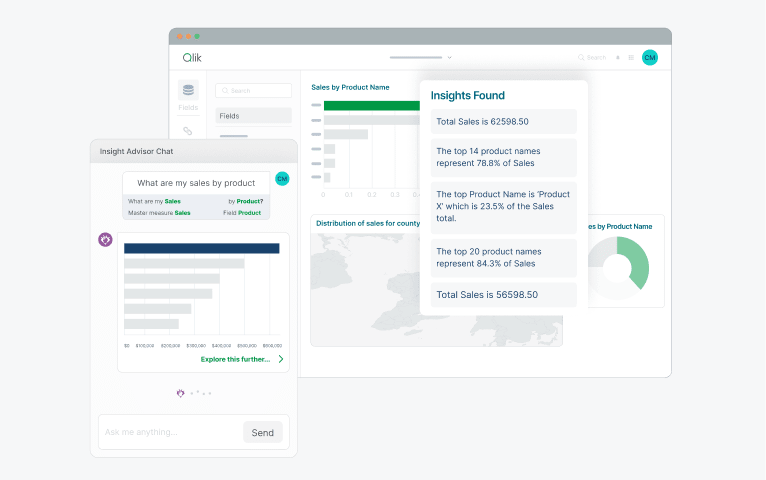

Automate data stewardship
AI agents spot issues and recommend fixes. Stewards review and approve. Governance scales without cutting corners.
Learn More

Build upon your existing AI tools
Use coding agents like Claude Code and GitHub Copilot to build pipelines, or connect any agentic system through Qlik's MCP Server.
Learn More

Leading technology partners
Deep integrations with AWS, Snowflake, Databricks, Anthropic, and more. Connected, flexible, no lock-in.
Learn MoreKEY RESOURCE
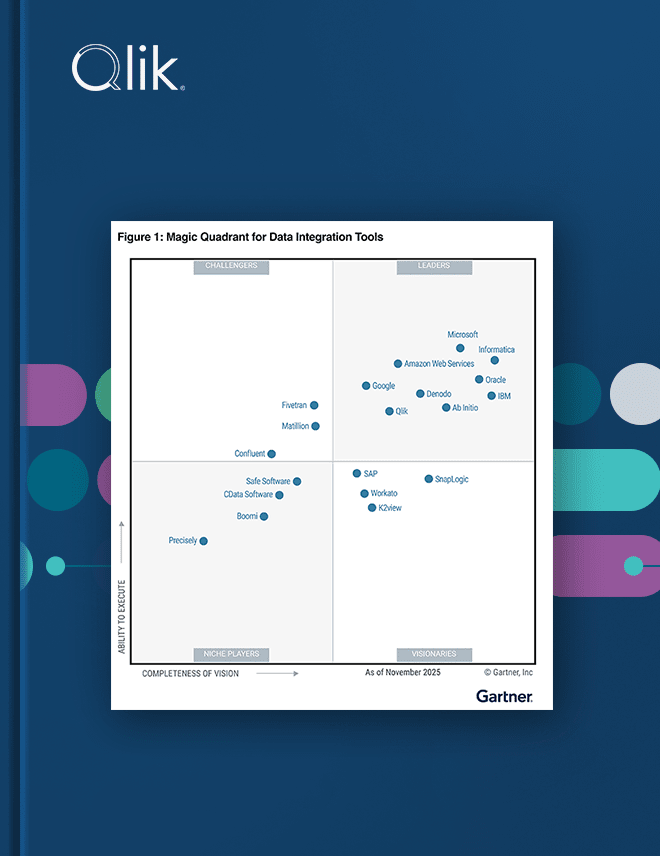
2025 Gartner® Magic Quadrant™ for Data Integration Tools
For the 10th consecutive year, Qlik was recognized as a Leader in the 2025 Gartner® Magic Quadrant™ for Data Integration Tools. Learn why in this complimentary report.

Qlik Talend Cloud Packaging
But what about my budget?
Automate data integration and support a wide variety of targets, formats and architectures.
Details
4 packages to choose from
Expand capabilities as needed
Priced based on data volume
Frequently Asked Questions (FAQs)
Data integration is the process of combining data from different sources into a unified, consistent view so it can be used for analytics, reporting, AI, and operations. It typically involves extracting data from source systems, transforming it into a common format, and delivering it to targets like warehouses, lakes, or applications. It's foundational to almost every data initiative, since reliable insights and AI depend on bringing scattered data together.
A data integration platform is software that provides the tools to connect to many data sources, move and transform data, and deliver it to target systems — often adding quality, governance, and monitoring in one place. Rather than stitching together separate point tools, a platform supports multiple patterns such as batch, real-time, ETL, ELT, and APIs across cloud, on-premises, and hybrid environments. It gives organizations a unified, scalable foundation for delivering trusted data.
A data pipeline is a series of automated steps that move data from one or more sources to a destination, often transforming it along the way. It handles the flow of data — extraction, transformation, validation, and loading — so information arrives in a usable, reliable form for analytics or applications. Pipelines can run in scheduled batches or continuously in real time, and they're the backbone of modern data infrastructure.
A data connector is a prebuilt component that lets a data platform connect to a specific source or target — such as a database, SaaS application, or cloud service — without custom coding. Connectors handle the technical details of authentication, data formats, and communication, so teams can quickly link systems together. A broad library of connectors lets an organization integrate many systems and add new ones easily as needs change.
Data architecture is the overall design of how an organization's data is collected, stored, integrated, managed, and used across its systems. It defines the models, standards, and flows that connect sources, storage such as warehouses and lakes, and the people and applications that consume the data. A well-designed architecture — whether centralized, fabric, or mesh — keeps data reliable, secure, and accessible as needs grow.
A data foundation for AI is a well-integrated, high-quality, and governed base of data that AI and machine learning systems can rely on to produce accurate, trustworthy results. It brings together the integration, quality, metadata, and governance needed so models and applications are trained and grounded on data that is accurate, current, and secure. Because AI outputs are only as good as their inputs, a strong data foundation is widely considered essential to successful AI.
Metadata management is the practice of managing "data about data" — the information that describes what data means, where it came from, how it's structured, and how it's used. Done well, it makes data easier to discover, understand, trust, and govern, typically through tools like data catalogs and lineage. It's a foundation for governance, self-service analytics, and reliable AI, because it gives essential context to raw data.
Cloud data integration is the practice of combining and moving data across cloud-based systems, and between cloud and on-premises sources, using services hosted in the cloud. It offers elastic scalability, faster setup, and lower maintenance than traditional on-premises integration, and it's well suited to connecting the many SaaS and cloud platforms organizations use today. It's a common foundation for cloud analytics, data warehousing, and AI.
Hybrid data integration is integrating data across a mix of environments — some on-premises and some in one or more clouds — so data can flow between them reliably. It lets organizations modernize gradually and keep certain data on-premises for security, compliance, or latency reasons while still using cloud analytics and AI. Supporting hybrid scenarios matters because most enterprises run a combination of legacy and cloud systems.
Data as a service (DaaS) is a model in which data is made available on demand through cloud-based services, so consumers can access trusted, ready-to-use data without managing the underlying storage or integration. It treats curated data as a product that internal teams or external partners can consume through standard interfaces. DaaS improves accessibility and consistency, letting people get the data they need quickly while it stays centrally governed.
Data orchestration is the automated coordination of data flows and processes across multiple systems and pipelines, so the right data moves through the right steps in the right order. It manages dependencies, scheduling, and error handling across ingestion, transformation, and delivery, keeping complex workflows running reliably end to end. As data environments grow more distributed, orchestration is what keeps pipelines coordinated and dependable.
ETL and ELT describe two orderings of the same three steps — extract, transform, and load — and the key difference is when the data is transformed. In ETL, data is transformed before it lands in the target, which suits cases where it must be cleansed, standardized, or made compliant first. In ELT, raw data is loaded into a powerful cloud warehouse or lakehouse and transformed there, taking advantage of that platform's scalable compute; many modern pipelines use whichever approach fits each workload.
Change data capture (CDC) is a technique that continuously tracks changes — inserts, updates, and deletes — made to a data source, so only those changes are moved downstream. This is far more efficient than repeatedly copying entire datasets, and it keeps target systems current with minimal delay. CDC can be implemented in several ways, but the log-based method — reading the database's transaction log — is preferred because it captures every change with very little impact on the source.
Both aim to make distributed data easier to use, but they approach it differently. A data fabric is primarily a technology approach — an integration and metadata layer that automatically connects and manages data across environments to provide unified, governed access. A data mesh is primarily an organizational approach that decentralizes ownership to the business domains that know the data best, treating each domain's data as a product. The two aren't mutually exclusive, and many organizations blend fabric-style automated integration with mesh-style domain ownership.
Agentic data engineering applies AI agents to the work of building and running data pipelines, shifting engineers from writing every step by hand to describing the outcome they want. The agents handle routine tasks — generating pipelines, checking quality, detecting issues, and monitoring — while people review, approve, and set the guardrails. This lets data teams move faster and spend more time on architecture and strategy rather than repetitive maintenance.


